City we serve
New Home Gutters and Guards in Gretna, NE 68028
Gretna is filling in fast with new houses, and the best time to get gutters right is before the sod goes down. Downspout placement and drain lines planned with the grade save a lot of digging later.
Gretna at a glance
- Area
- Gretna, NE
- ZIP
- 68028
- County
- Sarpy County, NE
- Office
- Omaha office, 516 South 13th Street
- Phone
- Answered 24/7
Quick answer
For Gretna we hang seamless gutters on new homes and additions, plan downspouts around the grading and landscaping, run underground drain lines, and fit guards before the first season of seeds and fluff. We also upgrade builder gutters that came up short. Call us any time to talk timing for your build.
Gretna started in 1886, when the Burlington Railroad built a line between Omaha and Ashland, and it was incorporated in 1889. For most of its history it was a small Sarpy County town. That changed quickly: the Census Bureau counted about 5,100 residents in 2020 and estimated more than 9,200 for 2025.
Nearly doubling in five years means a lot of new roofs, and many of them get gutters as an afterthought, hung at the tail end of the build with whatever the schedule allowed. We would rather be part of the plan. If you are building or just closed on a new Gretna house, call us before the yard is finished.
New Gretna houses and the gutter decisions that come with them
Most new homes around Gretna are two-story houses or ranches with walkout basements, on lots graded to fall toward a swale or the street. The roofs are steeper and more cut up than on older houses, with front gables, hip sections and valleys over the garage. Every one of those features pushes water toward a handful of corners.
The decisions that matter happen early. Where the downspouts land needs to match the grading plan, because a downspout that empties onto a patio or into a window well is hard to move once concrete is poured. We look at the framed house, mark outlet locations and coordinate with the builder so new construction gutters go up after the fascia and before final grade.
Open ground, young trees and fluff on the wind
New subdivisions here have young trees, so leaves are not the problem yet. The problem is everything that blows across open ground: cottonwood seed drifting in late spring like a snow squall from older trees along creeks and windbreaks, shingle grit off brand new roofs, and dust from lots still under construction.
Bare soil around a new foundation also moves easily. A 1-inch rain on a 1,000 square foot roof sheds more than 600 gallons, and until the lawn takes hold, that water carves channels wherever a downspout empties. Nebraska Extension suggests grading soil about 2 percent away from the house, and the downspouts should work with that slope, not against it.
Most called jobs here
What we recommend for Gretna homes
New Construction Gutters
Gutters timed after the roof and fascia but before final grade let us place outlets where the drainage plan needs them, so no downspout dumps onto a walkway or toward the walkout.
More on this serviceUnderground Downspout Drains
Running buried lines before the sod goes in is far easier than trenching through a finished lawn. Solid pipe to a pop-up emitter or daylight carries water well past the backfill.
More on this service6-Inch Seamless Gutters
Steep roofs with several valleys over a three-car garage overwhelm standard gutters in a heavy storm. Six inch runs on those faces keep water from sheeting over the front edge.
More on this serviceMicro-Mesh Gutter Guards
Fine stainless mesh stops cottonwood fluff and shingle grit, which is most of what lands in a new Gretna gutter. Adding it at install time costs less than a return trip later.
More on this serviceValley Splash Guards
Water racing down a long valley overshoots the inside corner of the gutter. A splash guard at that corner keeps it in the trough and off the new landscaping below.
More on this serviceKick-Out Flashing
Where a lower roof meets a two-story wall, water runs down the siding unless a kick-out sends it into the gutter. Some new homes miss it, and the rot shows up years later.
More on this service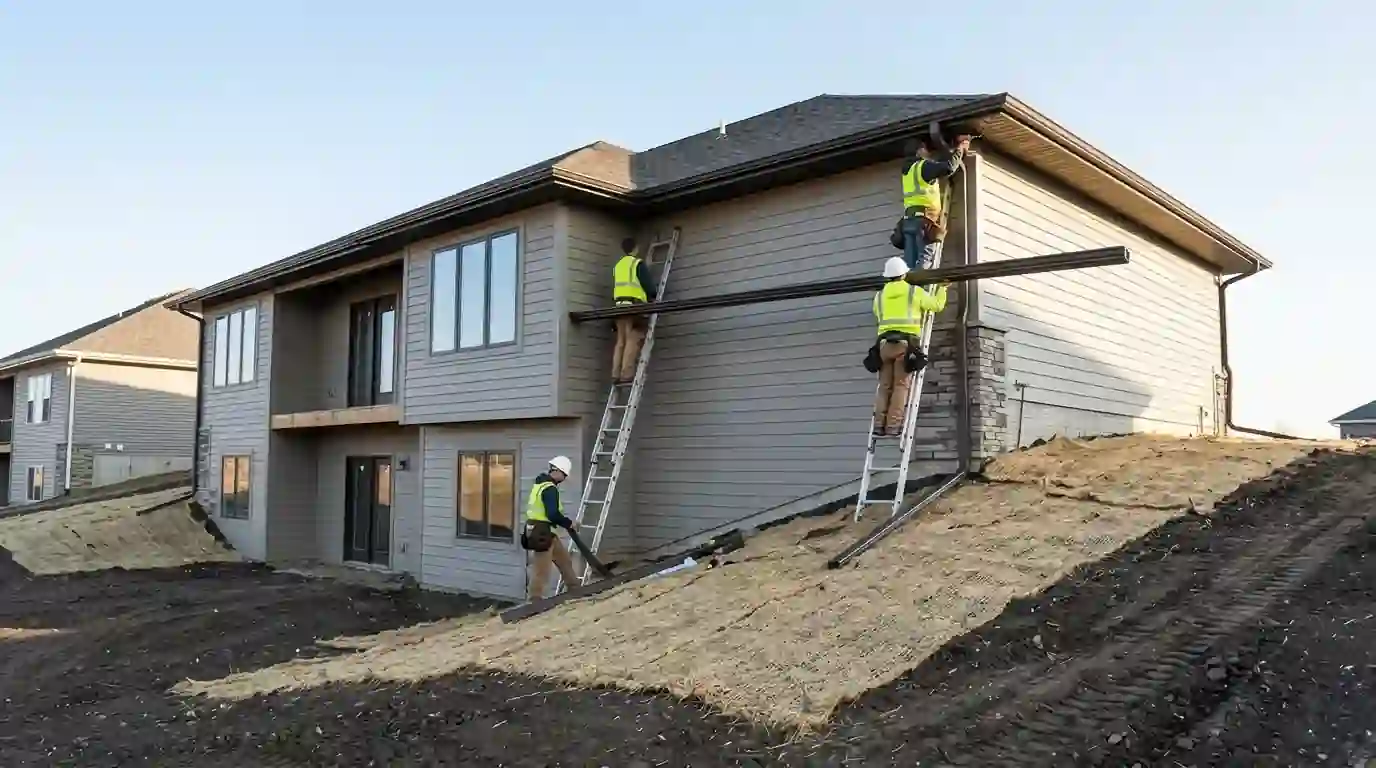
Gretna on the map
Gretna sits along Interstate 80 on the southwest edge of the metro, with Papillion to the east, Springfield to the southeast and the Platte valley toward Ashland to the southwest, the same direction the old Burlington line ran. Our crews cover the new subdivisions as well as the original town blocks, where older homes have their own set of gutter needs.
Gutter work in Gretna, answered any hour
Call for seamless gutters, repairs, guards or a clean-out. We talk through the job on the phone and set a time to measure.
FAQ
Gutter questions from Gretna
When should I schedule gutters on a new Gretna home?
After the roof, fascia and soffit are done and before the final grade, sod and concrete flatwork. That window lets us place downspouts where the grading plan sends water and lets the builder or landscaper plan around drain lines. If the house is already finished we can still do it, but moving a downspout later often means cutting into sod or working around a patio.
My Gretna builder already put up gutters. Is it worth changing them?
Sometimes. Builder packages often use 5-inch gutters and 2x3 downspouts with as few outlets as possible. If you see water spilling over the front in a hard rain, downspouts dumping near the walkout or valley water overshooting a corner, it is worth adding outlets, upsizing busy runs or extending the discharge. Many of those fixes are small, and our price guide shows typical ranges.
Do I need gutter guards on a new house in Gretna with no big trees?
Not always on day one, but think about what actually lands in the gutter. Here that is mostly cottonwood fluff blowing in from older trees, grit off new shingles and construction dust. Micro-mesh handles all three. Adding guards when the gutters go up is simpler than adding them later, and the young trees in your yard will keep growing.
How far should buried downspout lines run on a Gretna lot?
Far enough to clear the backfilled soil around the foundation and reach ground that slopes away, which is often 10 feet or more on a walkout lot. We lay buried drain lines in solid pipe with a steady fall to a pop-up emitter or a daylight outlet at the swale, and we call 811 first so fresh utility lines in the subdivision get marked.