Fascia, soffit and roof edge
Kick-out flashing in Omaha, NE where roofs meet walls
Where a garage or porch roof runs into a taller wall, water can slide down the wall behind the siding and rot the framing long before anyone sees a stain inside.
- Phone answered 24/7
- Our own crews
- Measured and priced on site
 Omaha, Nebraska
Quick answer
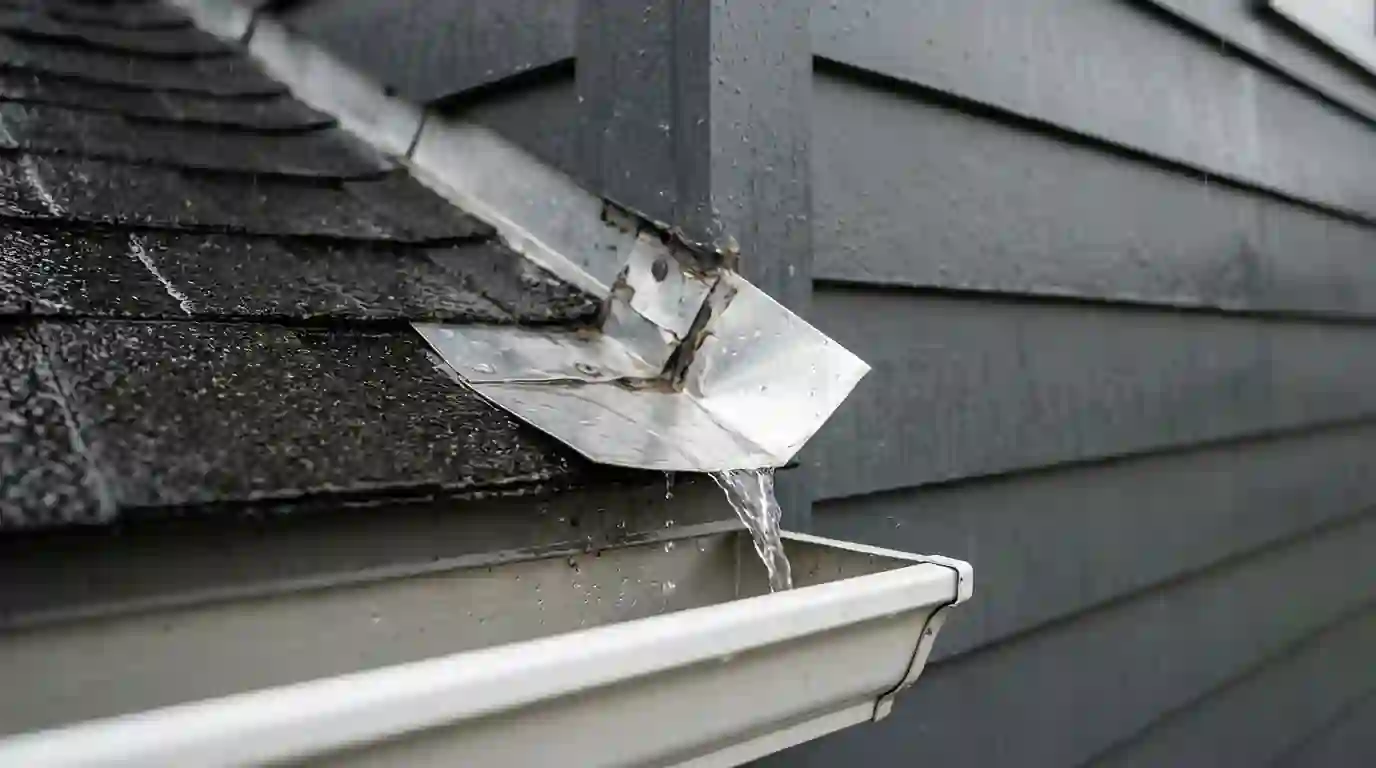
Kick-out flashing is a small bent metal diverter installed at the bottom of a roof-to-wall joint, right where the roof edge ends next to a wall. It turns water out into the gutter instead of letting it run down the wall. You need it anywhere a lower roof meets a sidewall, such as a garage beside a two-story.
The joint where a lower roof meets a taller wall is one of the most common leak points on a house. Step flashing protects the joint along its length, but at the very bottom, water flowing down the roof has nowhere to go except straight down the face of the wall.
A kick-out is a simple piece of metal that fixes that. It is a few inches long, costs little to make, and is often missing on houses built before builders paid attention to it. We add kick-outs as part of gutter work at those corners.
Where kick-outs belong
Any place a sloped roof ends against a vertical wall needs one. The classic spot is an attached garage beside a two-story house, where the garage roof eave dies into the side of the taller wall. Porch roofs, bay windows with small roofs and additions with lower roof lines create the same corner.
On those corners, the gutter usually stops a few inches short of the wall, or it butts into the siding with an end cap. Without a kick-out, the water running down the step flashing lands just behind that end cap and into the wall.
- Attached garage roofs ending against a two-story wall
- Front porch roofs meeting the main house wall
- Dormers and bay window roofs
- Additions and sunrooms with lower roof lines
- Split-level homes where roof planes step down
What happens without one
Water that misses the gutter at that corner runs down the wall surface, finds the gaps behind siding and soaks the sheathing and framing. On stucco and brick veneer homes, it gets trapped behind the finish and can rot the wall for years without a visible sign on the outside.
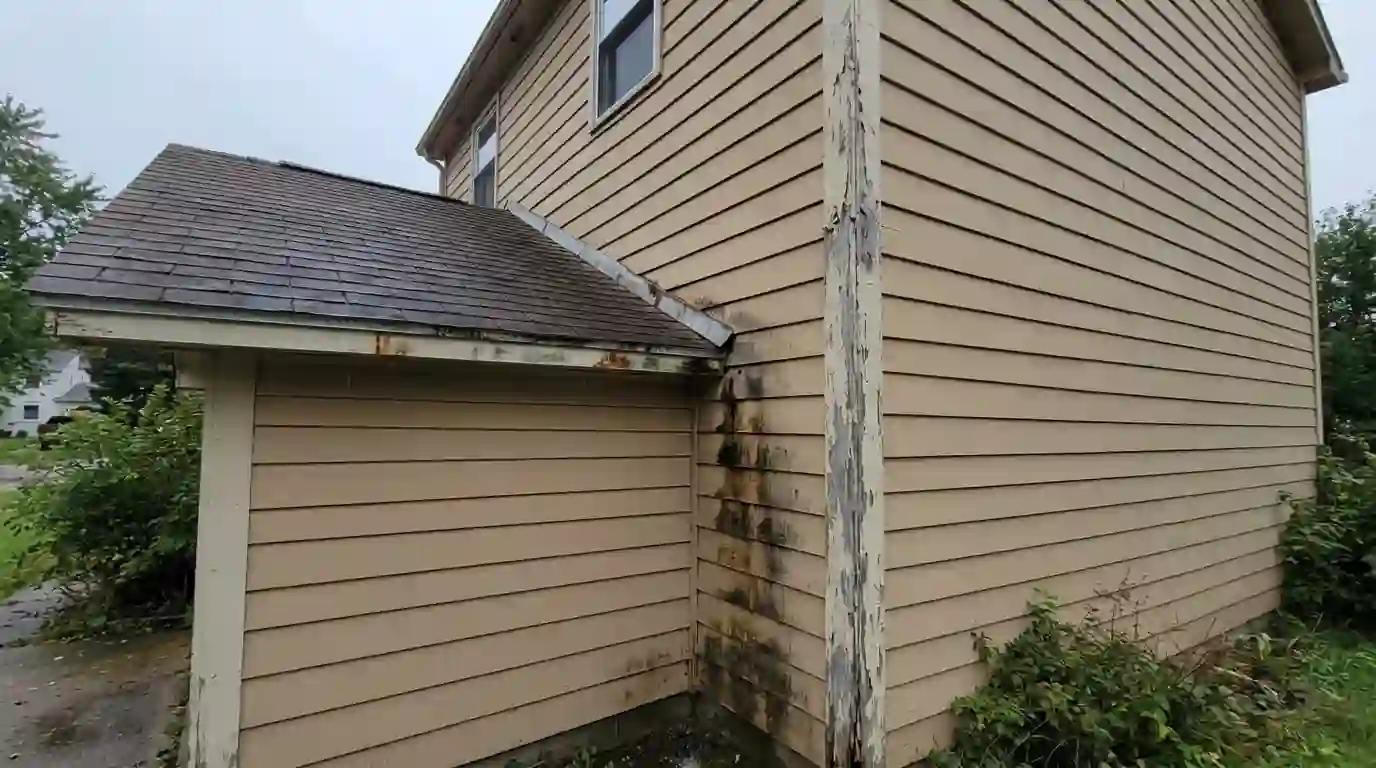
Inside, the first clue is often a stain on drywall below a window near that corner, or a musty smell in a closet. Outside, look for streaks running down the siding below the roof-to-wall joint, peeling paint, or soft wood at the bottom of the corner trim.
How kick-out flashing works
A kick-out is a piece of flashing with a closed bottom and a flared outlet that angles away from the wall. It sits at the lowest step flashing, under the siding or housewrap, so water coming down the joint is caught and directed out into the gutter.
The gutter end has to line up with it. We set the gutter so the kick-out empties into the trough and not onto the ground, and we check that the end cap and outlet near that corner can handle the extra flow. Prefabricated kick-outs and site-bent metal both work when installed correctly.
Retrofitting with siding work
Doing it right means getting the kick-out behind the siding and lapped correctly with the step flashing and housewrap. On vinyl or lap siding, that usually means removing a few courses of siding at the corner, installing the flashing and reinstalling the siding.
We coordinate with your siding contractor when siding needs to come off, or handle simple removal on vinyl where it can be unclipped and reset cleanly. Brick, stone and stucco retrofits are more involved, and we will explain the options before any work begins. When we do a gutter replacement at that corner, the kick-out goes in at the same time.
Fixing the damage behind the wall
If water has been running down the wall for a while, the kick-out is only part of the job. We look at the corner trim, the siding near the bottom of the joint and the fascia end at that corner. Soft wood there often needs replacing before the new flashing goes in.
Wall sheathing and framing repairs are beyond gutter work, and we will tell you if what we see points to that. In many cases, the damage is limited to trim and a short section of fascia, which we can handle as part of the same visit.
What to look for
Signs you are missing a kick-out
Streaks down the sidewall
Dirty water lines running down the siding directly below where a lower roof meets the wall mean water is bypassing the gutter at that corner.
Rot at the corner trim
Soft or crumbling trim boards at the bottom of the roof-to-wall joint show that water has been soaking that spot for a long time.
Interior stain near the corner
A water mark on drywall or ceiling inside, near the corner where the garage or porch roof meets the house, often traces back to a missing kick-out.
Gutter end cap against siding
A gutter that dead-ends into the siding with only a cap, and no diverter above it, usually lets water drop behind the gutter at that spot.
Peeling paint low on the wall
Paint failing in a narrow band below the roof joint, while the rest of the wall looks fine, is a classic sign of repeated wetting.
Mulch washed out below
A trench or bare patch in the bed directly under the corner shows water has been pouring down the wall there instead of into the gutter.
How the job goes
How we install kick-out flashing
- 1
Find every roof-to-wall corner
We walk the house and mark every place a roof edge ends against a sidewall, then check each for an existing kick-out, staining, rot and how the gutter meets the wall.
- 2
Open the wall at the corner
Where siding allows, we remove a few courses at the bottom of the joint to reach the lowest step flashing and check the sheathing and trim behind it.
- 3
Repair soft trim and fascia
Rotted corner trim or a soft fascia end is replaced with new wood before any flashing goes in, so the corner has a solid base again.
- 4
Set the kick-out and lap it
The kick-out is installed at the bottom of the step flashing, lapped under the housewrap and sealed so water coming down the joint is turned outward.
- 5
Align the gutter and close up
The gutter end is adjusted so the kick-out empties into it, siding is reinstalled, and we run water down the roof joint to confirm the flow lands in the gutter.
Pricing
What kick-out flashing costs
National cost guides do not list kick-out flashing as its own item, so the closest honest references are small repair rates and edge flashing by the foot. The actual price depends on how much siding has to come off. See our price guide for more.
| Item | Published range |
|---|---|
| Closest match: minor repair visit | $75 to $300 |
| Edge flashing, per foot, as a reference | $1 to $3 per foot |
| If rotted fascia must be replaced | $7 to $40 per foot |
National ranges published by HomeGuide, Angi, This Old House. Your price depends on the house; we give you a number on the phone or at the house before any work starts. See the full gutter price guide.
Siding type matters most: vinyl unclips easily, while brick, stone and stucco take more work. Rot behind the corner, second-story height and the number of corners all move the total.
Omaha conditions
Kick-outs on Omaha homes
Omaha has many split-level and ranch homes with attached garages, plus newer two-story houses where the garage roof dies into a taller wall. Those corners collect a surprising amount of water, since a 1 inch rain on just 1,000 square feet of roof sends more than 600 gallons off, and part of that water runs down each roof-to-wall joint.
May, June and August bring the heaviest rain here, often in short, hard storms. A missing kick-out at a garage corner might not show any damage for several seasons, then turn up as a soft wall when siding is finally removed. Adding one during gutter work is a small step that prevents a large repair.
Talk to a gutter crew about kick-out flashing
Tell us what you are seeing at the roof edge. We answer around the clock and give you straight answers on repair or replacement.
FAQ
Kick-Out Flashing questions
My house is fairly new. Could it still be missing kick-outs?
Yes. Kick-outs were often skipped during the building boom years, and even newer homes sometimes have them installed poorly or hidden behind siding with the outlet pointing the wrong way. We check every roof-to-wall corner regardless of the house age. It only takes a few minutes per corner to see whether one is there and working.
Can kick-out flashing be installed without removing siding?
Sometimes, as a surface-mounted retrofit, but it is not ideal. The best installation sits behind the siding and laps with the step flashing and housewrap. A surface-mounted kick-out relies on sealant that ages. We explain the tradeoff and recommend going behind the siding when it can be done without major disruption.
Is kick-out flashing the same as a valley splash guard?
No. A kick-out sits where a roof edge meets a vertical wall and turns water away from that wall. A splash guard sits on the gutter at an inside roof corner where a valley sends water shooting over the front. Both protect corners, but they solve different problems. See valley splash guards for the other one.
Will a bigger gutter fix the problem at a roof-to-wall corner?
Not by itself. The trouble at that corner is water running down the wall before it ever reaches the gutter. A larger gutter will catch more roof water elsewhere, but without a kick-out, the water traveling along the wall still bypasses it. The kick-out is what puts that water into the gutter in the first place.
What if my house has brick or stucco at the roof corner?
Those walls are harder to retrofit because the finish cannot simply be unclipped. Options include cutting a neat slot to fit the kick-out and resealing, or installing a surface-mounted diverter with careful sealing. We will show you what is possible at your corner and point out if a masonry or stucco contractor should be involved.
Related gutter services
Checking costs? The gutter price guide lists published ranges, the gutter size calculator estimates 5 or 6 inch and downspout count, and the cleaning schedule planner shows how often your trees fill the gutters.