Downspouts and drainage
Underground Downspout Drains in Omaha, NE
Some corners of a house have nowhere good to send roof water above ground. A patio, a driveway or a lawn that tilts the wrong way blocks every extension you try.
- Phone answered 24/7
- Our own crews
- Measured and priced on site
 Omaha, Nebraska
Quick answer
An underground downspout drain is a buried pipe that picks up water at the base of a downspout and carries it to a lower spot in the yard, where it exits through a pop-up emitter or an open daylight outlet. It fits homes where surface extensions would cross walks, trip people or still drain back toward the foundation.
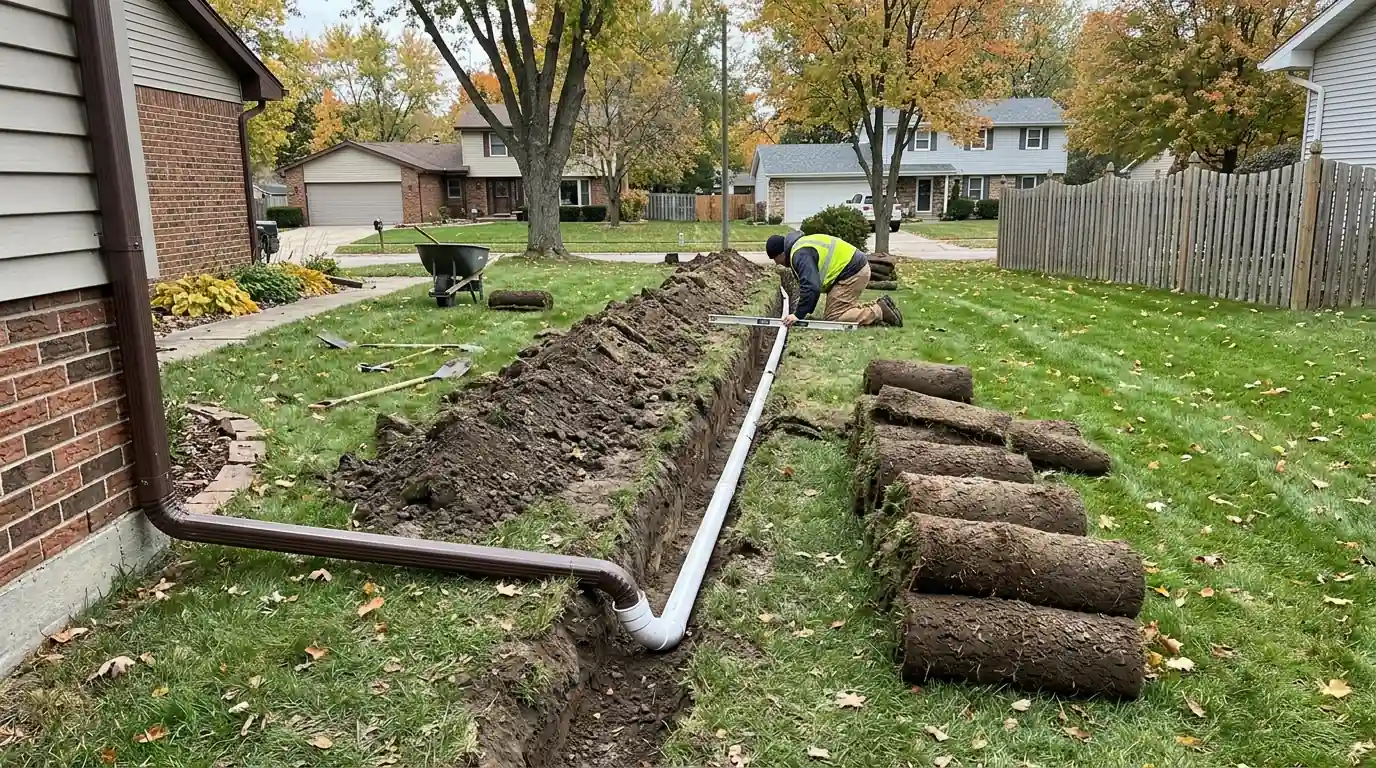
A buried line does the same job as an extension, just out of sight and over a longer distance. We trench from the downspout to the discharge point, set pipe on a steady fall, and backfill so the lawn closes over it. Done right, you forget it is there until a storm, when water quietly bubbles out at the far end of the yard.
Done wrong, it becomes a buried clog that pushes water back up the downspout and over the gutter. Most of the failed lines we dig up share the same faults: flexible black pipe with ridges that trap silt, a dip in the middle where water sits and freezes, and no way to clean it. We build ours to avoid all three.
Solid PVC versus corrugated pipe
Corrugated tubing is cheap and bends around obstacles, which is why it shows up on so many builder jobs. The ridges inside catch shingle grit, seed pods and fluff, and the thin wall crushes under a mower wheel or a parked trailer. Once a low spot forms, standing water in that low spot freezes in January and the line stops working until spring.
We use smooth-wall PVC, usually 4 inch, glued at each joint. The smooth bore keeps debris moving, the rigid pipe holds its slope over years of frost, and the fittings let us add a cleanout where the line changes direction. It costs more per foot, and it is the reason the line still runs a decade later.
Slope, outlets and cleanouts
Water in a buried pipe needs a steady fall the whole way, with no bellies. We aim for at least an eighth of an inch per foot and more when the yard allows, checking the trench with a level and a string line before any pipe goes down.
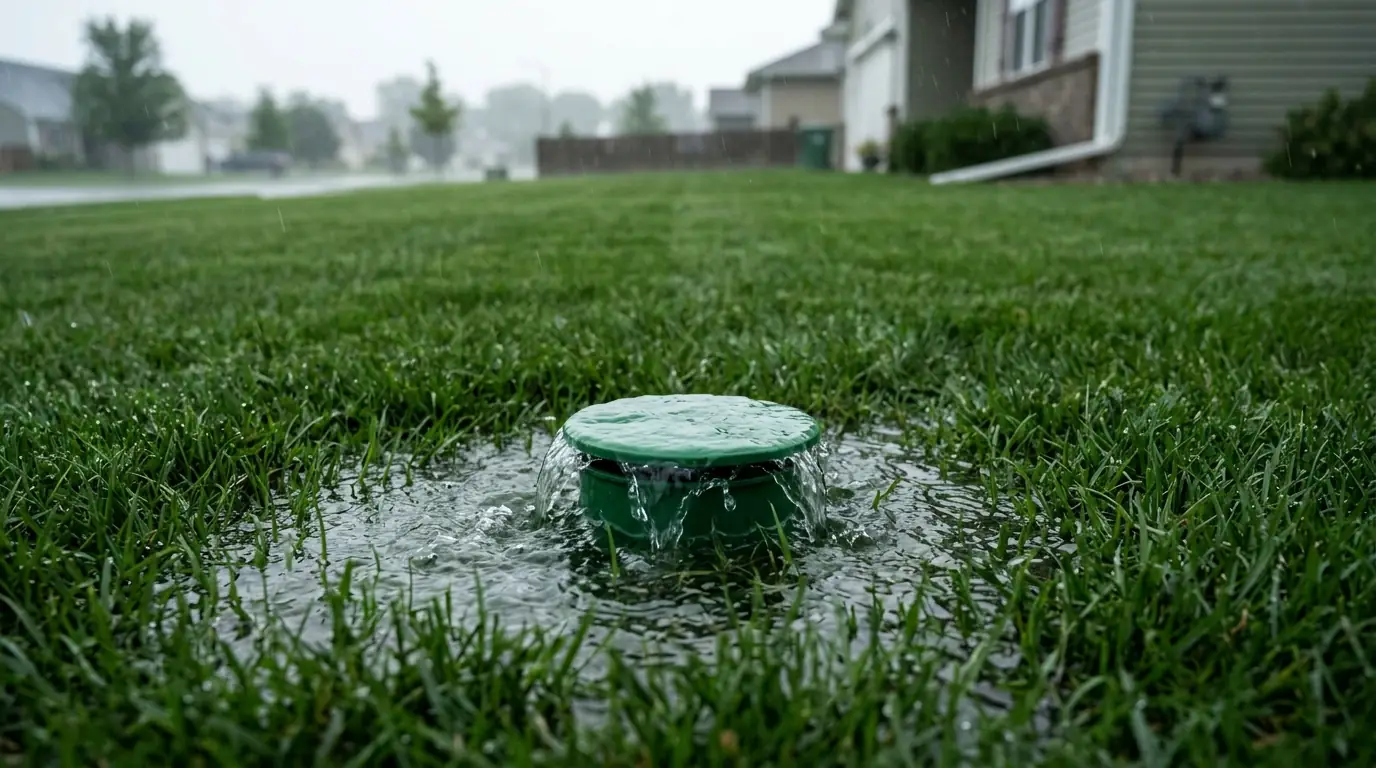
At the far end there are two common finishes. A pop-up emitter sits flush with the lawn and lifts open when water pushes up, then drops shut to keep out leaves and critters. A daylight outlet simply ends the pipe on a slope, at a ditch edge or near the curb where local rules allow. We add a cleanout near the downspout so a hose or snake can reach the line without digging.
A screened adapter where the downspout meets the pipe keeps the worst of the debris out. Pairing the line with micro-mesh gutter guards on the roof above cuts down what reaches it in the first place.
What we never connect to
Roof water does not go into the sanitary sewer, and we will not tie a downspout line into a floor drain, a basement sump crock or a sewer cleanout. Local rules generally prohibit that kind of connection, and in the older combined sewer areas it adds to the load that backs water into basements during heavy rain.
Before we dig, we call 811 so the utilities mark gas, electric, water and cable lines. Shallow irrigation lines and invisible pet fencing are not marked by 811, so we ask you about those on the first visit.
When a buried line is the right call
We recommend going underground when a downspout sits next to a driveway or patio, when the yard is flat for 15 feet or more, or when two or three downspouts can share one larger trunk line to a single outlet. It also suits homes where a surface extension would end up aimed at a neighbor.
For a corner where a hinged downspout extension would work fine, we say so. A buried line is more digging and more cost, and it only pays off where the surface options run out.
- Downspouts beside drives, walks or patios
- Flat or back-sloping lots
- Several downspouts sharing one trunk line
- Corners where water would cross a property line
What to look for
Signs a buried drain is clogged or failing
Water bubbling at the downspout
When the base of the downspout overflows or water spurts from the joint at ground level during rain, the line below is full or blocked.
Emitter never opens
A pop-up that stays shut through a hard storm usually means the pipe is clogged or crushed somewhere between the house and the outlet.
Soggy strip in the lawn
A wet or extra-green line across the yard often traces a cracked or separated pipe leaking along its route instead of reaching the outlet.
Sinkhole along the route
A small depression above the trench means water is escaping and washing soil into the pipe or away from it.
Gutter overflowing at one outlet
Overflow at the end of a run, right above a buried line, tends to mean the water has nowhere to go once it reaches the ground.
Ice at the base in winter
A column of ice inside the bottom of the downspout shows meltwater backing up from a frozen low spot in the line.
How the job goes
How we install a downspout drain
- 1
Plan the route
We find the lowest workable discharge point, call 811 for utility marks, and ask about sprinklers, pet fences and future landscaping plans before marking the trench line.
- 2
Cut and trench
Sod comes up in strips and is set aside. The trench is dug with a steady fall, checked against a string line, and kept clear of tree roots where possible.
- 3
Lay and glue pipe
Smooth-wall PVC is bedded on firm soil, glued at every joint, and fitted with a downspout adapter, a cleanout and the chosen emitter or daylight end.
- 4
Flow test
Before backfilling, we run a hose into the downspout and confirm water comes out the far end quickly with nothing pooling along the way.
- 5
Backfill and restore
Soil goes back in layers and is tamped, the sod is laid back over the trench, and the downspout is strapped tight to the new adapter.
Pricing
Underground drain pricing
Buried lines are priced mostly by length and by how hard the digging is. One of the rows below is a contractor estimate from the Chicago area rather than Omaha, so treat it as a ballpark.
| Item | Published range |
|---|---|
| Buried PVC drain line, per foot (Chicago area estimate) | $15 to $25 per foot |
| Downspout pipe to the adapter, per foot | $7.52 to $31.79 per foot |
| Clearing a clogged downspout first | $60 to $150 |
National ranges published by Ware Landscaping, Fixr, HomeGuide. Your price depends on the house; we give you a number on the phone or at the house before any work starts. See the full gutter price guide.
Long runs, tree roots, cutting under a sidewalk and multiple downspouts joined to one trunk line push the price up. Short, open runs across lawn sit at the low end.
Omaha conditions
Buried drains in Omaha soil
Omaha's combined sewer system covers about 43 square miles of the older city, with shared pipes that carry sewage and stormwater together. When those pipes fill in a cloudburst, water can back up into basements, which is why the city has offered help with backflow valves. Keeping roof water on your own lot and out of the sewer is part of the same effort, and it protects your basement as well.
The fine loess silt under much of the metro trenches cleanly but slumps when it gets saturated, so we firm the trench bottom before laying pipe and avoid leaving a soft bed that could sag into a belly later. Lines in the Iowa side towns and out toward Lincoln get the same treatment. If you want the bigger picture on drainage and wet basements, our downspout and basement guide covers it, and you can call us to plan a route.
Talk to a gutter crew about underground downspout drains
Tell us what you are seeing at the roof edge. We answer around the clock and give you straight answers on repair or replacement.
FAQ
Underground Downspout Drains questions
Do pop-up emitters freeze shut in an Omaha winter?
They can, but a properly sloped line drains empty after each storm, so there is little water left to freeze. The lid may stick under snow or ice, and meltwater then waits in the pipe until it thaws. That is why we keep the fall steady and avoid low spots. If a line runs to a slope, a daylight outlet sidesteps the lid issue entirely.
Can two downspouts share one underground line?
Yes, as long as the pipe is sized for both. We often join two downspouts on the same side of a house into one trunk with a wye fitting and run a single line to the outlet. Three or more, or a large roof plane feeding them, may call for a bigger pipe or a second outlet so the line does not back up in a heavy storm.
Why can the line not just go into my sump pit?
A sump pit is meant to collect groundwater from under the floor, and feeding roof water into it makes the pump run far more often and can overwhelm it in a downpour. It also puts that water right back next to the foundation. We keep downspout lines separate from sump discharge and from every sewer connection, and run them to the yard instead.
How deep do you bury a downspout drain line?
Usually shallow, often 6 to 12 inches of cover depending on the slope we need. Because the line drains empty between storms, it does not have to sit below the frost line the way a water supply pipe does. The depth is set by keeping a steady fall from the downspout to an outlet that is lower than where the line starts.
Is a buried line worth it over a long extension?
It depends on the corner. A buried line costs more and takes a trench, but it removes trip hazards, clears driveways and patios, and sends water much farther. Where a hinged extension already gets water 6 feet out onto ground that falls away, that is usually enough. We look at each downspout on its own and recommend the simpler fix where it works.
Related gutter services
Checking costs? The gutter price guide lists published ranges, the gutter size calculator estimates 5 or 6 inch and downspout count, and the cleaning schedule planner shows how often your trees fill the gutters.