Downspouts and drainage
Valley Splash Guards in Omaha, NE
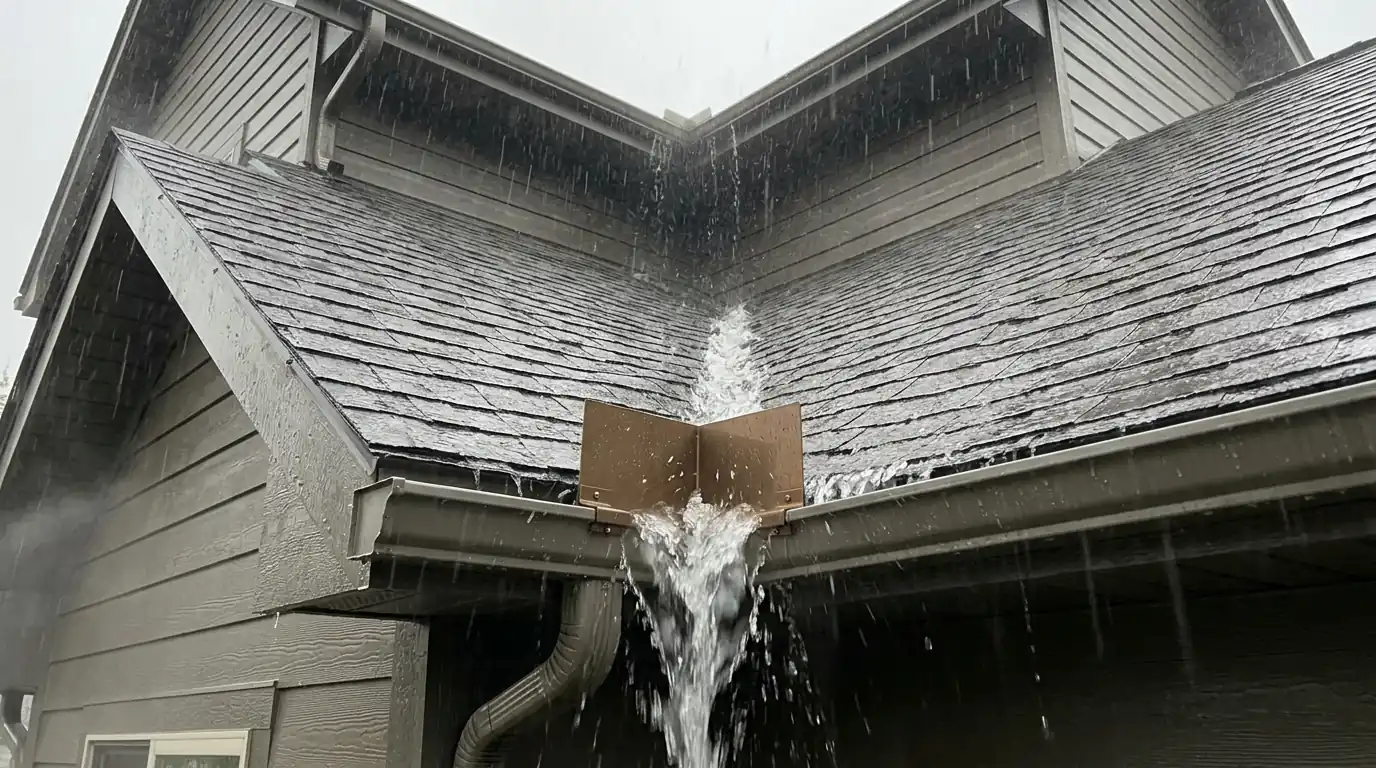
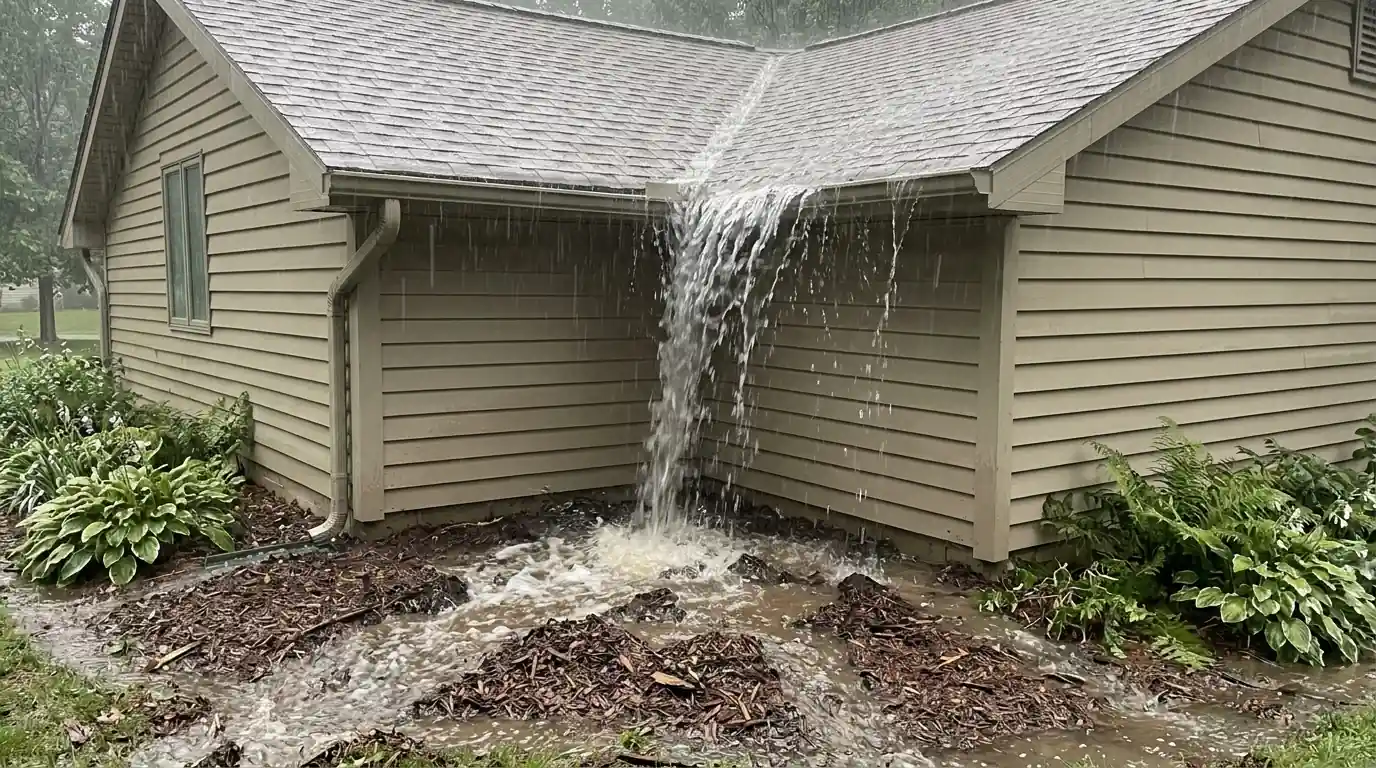
In a hard storm, water racing down a roof valley can jump right over the gutter at the inside corner and pour onto the bed, the deck or the walk below.
- Phone answered 24/7
- Our own crews
- Measured and priced on site
 Omaha, Nebraska
Quick answer
A valley splash guard is a short metal diverter fastened to the outer lip of the gutter where a roof valley empties. It catches water that would shoot past the gutter and turns it back into the trough. You need one when an inside corner overflows in heavy rain even though the gutter and downspouts are clear.
A valley is the channel where two roof slopes meet. It collects water from both planes and funnels it into one narrow stream, and on a steep roof that stream picks up speed all the way down. By the time it reaches the gutter at the inside corner, it can carry right over a 5-inch K-style front lip.
Homeowners often think the gutter is clogged, because they see water sheeting over the edge in the same spot every storm. We climb up, find the trough clean, and watch the overflow happen from a valley that simply outruns the gutter. A splash guard is the small, inexpensive fix for that exact problem.
What the guard actually does
The guard is a raised piece of aluminum, usually 4 to 6 inches tall and shaped to the gutter profile, that clips or rivets onto the front lip right where the valley water lands. It acts as a backboard. Water that would have cleared the gutter hits the guard and drops into the trough instead.
Some styles wrap around the miter at the inside corner, and some are a straight piece on one run. We pick the shape by watching where the water lands, not by guessing from the ground. Painted to match the gutter, it barely shows from the yard.
When a guard is not enough
A splash guard only redirects water. It does not add capacity. If the corner overflows because the gutter is too small for the volume, or because the nearest downspout is 30 feet away, the guard will catch the overshoot and the gutter will still spill over a few feet down the run.
At problem corners we often recommend going up to 6-inch gutters on the runs that take valley water, and adding a downspout close to the inside corner. The wider trough holds more water and its taller back gives more room for the stream to land. Combined with a guard, that usually ends the overflow for good.
- Overshoot only, gutter otherwise keeps up: splash guard alone
- Overshoot plus spill down the run: guard and a closer downspout
- Steep valley over a long run: 6-inch gutter, new outlet and guard
Valley types and how they shed water
Open metal valleys, common on older and higher-end roofs, are smooth and fast. Water moves through them with little drag, so they overshoot more than shingle valleys. Closed-cut and woven shingle valleys slow the water a bit with their texture, though a steep pitch still pushes it over the edge.
Metal roofs on sheds, garages and some newer homes are the fastest of all. Rain and melting snow slide off in sheets, and the corners where two metal planes meet see the worst overshoot. For garage and shop gutters under metal roofs, we treat splash guards as standard at every valley.
Splash guards versus kick-out flashing
These two get mixed up because both deal with water at a corner. A splash guard sits on the gutter and handles valley water. A kick-out flashing sits at the bottom of a roof edge where it runs into a sidewall, such as a garage roof meeting the wall of a two-story, and steers water into the gutter instead of down the siding.
If you see staining or soft siding below where a roof edge meets a wall, that is a kick-out flashing issue, not a valley one. We check both on the same visit, since they often show up on the same side of the house.
What to look for
Signs a valley is overshooting your gutter
Sheet of water at a corner
Water pouring over the gutter face at an inside corner in heavy rain, while the rest of the run drains normally, is the classic sign.
Trench in the bed below
A line of washed-out mulch or bare soil directly under an inside corner shows where valley water has been landing for months.
Splash marks on siding
Mud splatter on the lower siding or foundation under a corner means water is hitting the ground hard right next to the house.
Clean gutter, still spilling
If the gutter checks clean and the downspout runs freely but the corner still overflows, the water is outrunning the gutter rather than backing up.
Ice ridge at the miter
In winter, a buildup of ice on the front lip at an inside corner shows where meltwater has been splashing over and refreezing.
Wet patio or deck edge
A deck board or patio slab that stays wet longer than the rest, sitting under a valley corner, catches the overshoot every storm.
How the job goes
How we fix a valley overflow
- 1
Watch it in action
We run a hose into the valley from the roof, or come out during rain when you call us, to see exactly where the stream leaves the gutter and how far it travels.
- 2
Check the gutter and outlets
We confirm the gutter is clean, pitched toward the downspout and sized for the roof area, since a guard cannot fix a clog or poor slope.
- 3
Choose the guard
Straight or corner style, sized to the gutter profile and matched to the gutter color, placed so it covers the full landing zone of the stream.
- 4
Fasten and seal
The guard is riveted or screwed to the front lip with corrosion-safe fasteners and sealed where it meets the miter, so it adds no new leak points.
- 5
Retest and adjust
We run water through the valley again. If water still spills further down the run, we talk about a closer downspout or wider gutter on that section.
Pricing
What a splash guard repair costs
No published price list covers valley splash guards on their own, so the table uses the closest honest rows. A guard is usually done as a small repair visit, sometimes with a new downspout or a section of wider gutter.
| Item | Published range |
|---|---|
| Small repair visit, guard only | $75 to $300 |
| Typical repair visit with outlet work | $100 to $450 |
| New downspout near the corner | $30 to $75 per downspout |
| 6-inch upgrade on the valley run, per foot | $3 to $5 per foot |
National ranges published by HomeGuide, Angi. Your price depends on the house; we give you a number on the phone or at the house before any work starts. See the full gutter price guide.
A single guard on a one-story corner sits at the low end. Second-story access, several valleys and any gutter or downspout changes at the corner raise the total.
Omaha conditions
Why Omaha valleys overflow
Our summer storms do not drizzle. May, June and August are Omaha's wettest months, and much of that rain arrives in short, heavy bursts. City stormwater figures put the runoff from an inch of rain on 1,000 square feet of roof at more than 600 gallons, and a valley can collect a big share of that from two slopes at once.
Many newer homes in the metro growth areas have complex rooflines with several valleys over a single run of gutter, often on steep pitches. Those corners are the ones we see overflow most often. A guard is a small part, but on the right corner it keeps water out of the foundation bed and off the window wells. Our price guide shows what related work costs.
Talk to a gutter crew about valley splash guards
Tell us what you are seeing at the roof edge. We answer around the clock and give you straight answers on repair or replacement.
FAQ
Valley Splash Guards questions
Will a valley splash guard trap leaves at the corner?
It can catch a few leaves on its inside face, but the gutter corner was already the spot where valley debris piles up. The guard does not change that much. If your roof has heavy tree cover, a guard plus regular cleaning, or a gutter guard on that run, keeps the corner flowing. We shape the guard so it does not create a ledge for debris.
Can I just bend the front lip of the gutter up instead?
Bending the lip weakens the gutter face, throws off the hidden hangers that clip to it, and usually looks rough from the street. It also rarely adds enough height to stop a fast stream. A proper guard is cheap, matches the gutter color and fastens on without damaging the run. We see a lot of bent lips that ended up needing a section replaced.
Do splash guards work on half-round gutters?
Yes, but the guard has to follow the rounded profile, so we form or order one shaped for half-round rather than using a K-style piece. On copper half-round, the guard is copper too, so the metals match and do not corrode each other. The rest of the advice is the same: check capacity and outlet spacing before relying on the guard alone.
Why does only one corner of my house overflow?
That corner almost always sits under the longest or steepest valley, where the most water collects and builds the most speed. The other corners may take water from smaller valleys or none at all. It can also be the corner farthest from a downspout. We watch the water at that spot to tell which one it is before recommending a guard or more.
Is a splash guard enough under a metal roof valley?
Often not by itself. Metal sheds water and melting snow much faster than shingles, so valley corners under metal usually need a guard plus a wider gutter or a downspout close to the corner. Snow sliding off a metal roof can also bend a guard, so we use a sturdy style and fasten it well. Outbuildings with metal roofs are where we see this most.
Related gutter services
Checking costs? The gutter price guide lists published ranges, the gutter size calculator estimates 5 or 6 inch and downspout count, and the cleaning schedule planner shows how often your trees fill the gutters.