Downspouts and drainage
Downspout Installation in Omaha, NE
A gutter can only empty as fast as its downspouts allow. Too few, too small or in the wrong spot, and even a clean, well-pitched gutter overflows in a hard rain.
- Phone answered 24/7
- Our own crews
- Measured and priced on site
 Omaha, Nebraska
Quick answer
Downspout installation means adding new downspouts or replacing old ones, sized and placed to match the roof area each gutter drains. Most Omaha homes come with 2x3 downspouts. Moving to 3x4, or adding an outlet on a long run, is the usual fix when gutters overflow even though they are clean and properly sloped.
Homeowners usually blame the gutter when water pours over its front edge. Often the gutter is fine and the bottleneck is below it. A single 2x3 downspout at the end of a 45 foot run under a steep roof simply cannot pass the water a summer storm puts into that gutter.
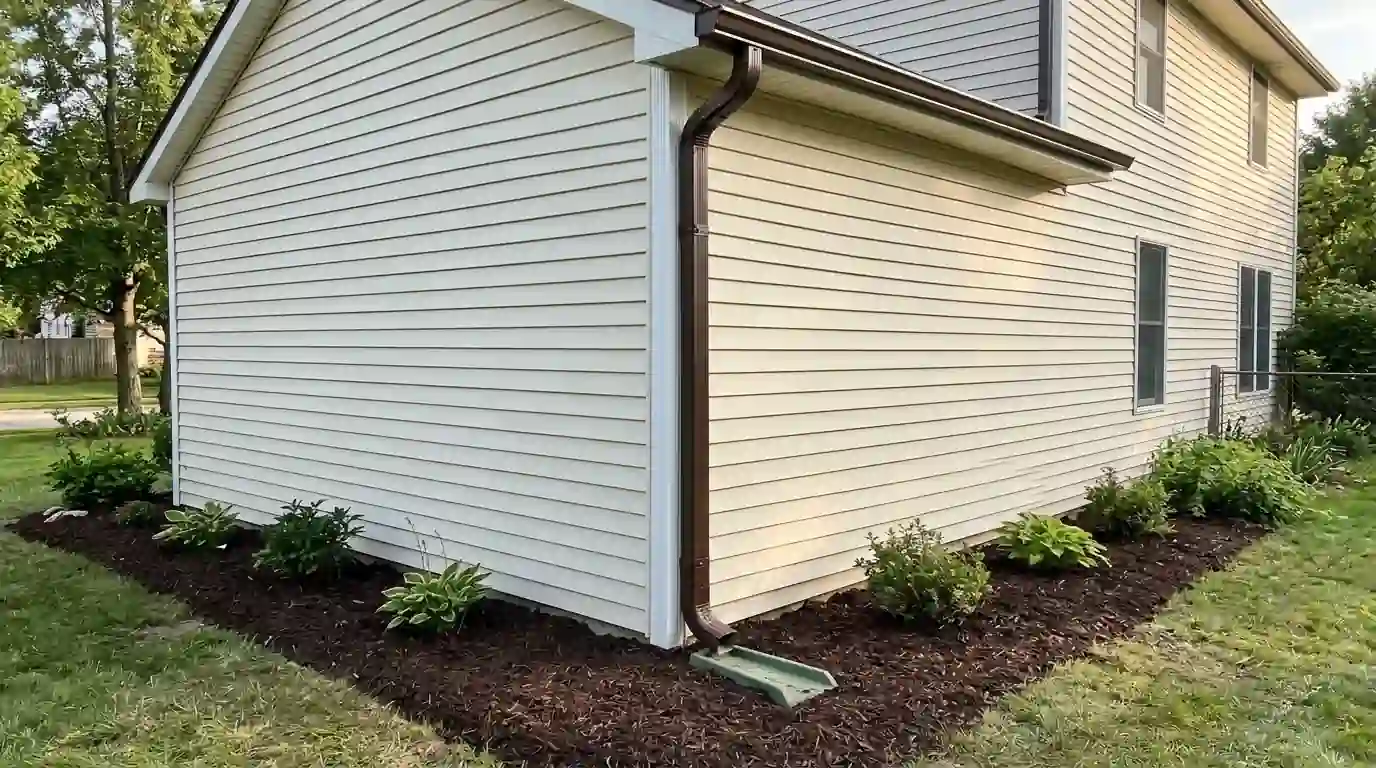
We look at downspouts as the drain for each section of roof. That means counting how much roof feeds each outlet, choosing the size, and deciding where the pipe comes down so its water lands somewhere useful, not on the patio or against the basement wall. We cut outlets clean, strap the pipe to the wall and match the color to your gutters.
2x3 versus 3x4 downspouts
A 2x3 downspout is the standard on many builder installs, and it handles average roof sections on 5-inch gutters. A 3x4 downspout carries roughly twice the water, which matters under steep or large roof planes and anywhere a valley empties into the gutter.
Larger downspouts also clog less. Maple seeds, cottonwood fluff and shingle grit pass through a 3x4 elbow that would pack a 2x3 shut. When we install 6-inch gutters, 3x4 downspouts are the normal pairing, and we often recommend them on 5-inch systems too.
How many downspouts, and where
A common working guide is one downspout for every 30 to 40 feet of gutter, with closer spacing under big or steep roof areas. Runs longer than that are often pitched both directions from a high point in the middle, with an outlet at each end.
Placement is as important as count. We look for spots where the downspout can come down a corner or along trim without crossing a window, and where the discharge can be carried away from the house. Water dumped next to a walkway freezes in winter. Water dumped beside a window well ends up in the basement.
- Outlets placed at the low end of each pitched run
- Downspouts on inside and outside corners where they look tidy
- Discharge kept away from walks, drives and window wells
- An extra outlet below valleys that flood the gutter
- Upper roof downspouts routed into lower gutters only when the lower gutter can take the load
Outlets, elbows and straps
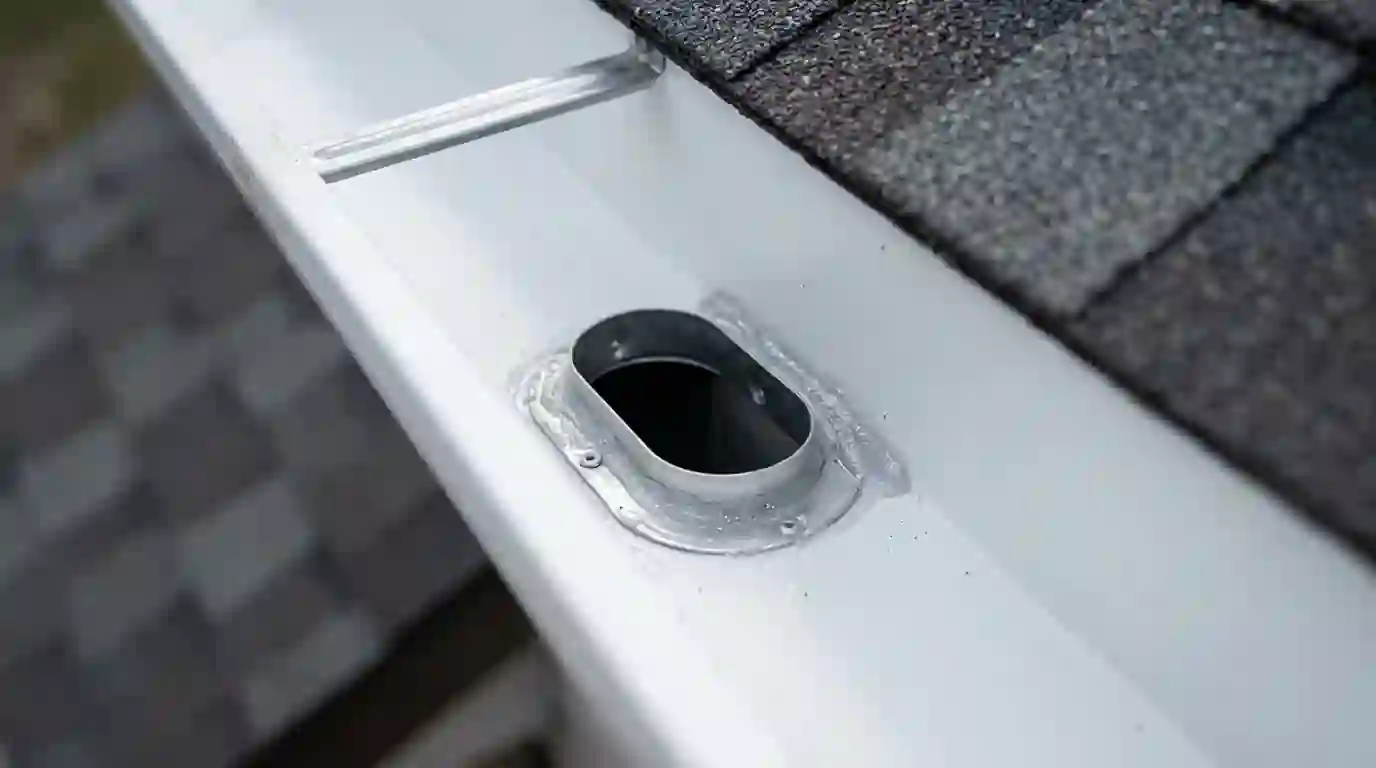
The outlet is where most downspout problems start. We cut the hole cleanly in the gutter bottom, set a crimped drop outlet, and seal and rivet it so it does not leak or catch debris on a jagged edge. An outlet cut too small, or with burrs left on the edge, is a clog waiting to happen.
From the outlet, elbows carry the pipe back to the wall. We use as few elbows as the eave allows, since every turn slows water and catches seeds. Straps go on at the top, the bottom and at intervals in between so the pipe stays tight to the wall in wind.
Adding downspouts to overflowing runs
If a run overflows near its middle or its dead end while the downspout runs full, a second outlet is usually the fix. We cut it in at a point that splits the run, re-pitch the gutter toward both outlets if needed, and bring the new downspout down where its water can go somewhere sensible.
This is often cheaper than replacing the gutter. If the run also holds water, our re-pitching service sets the slope correctly at the same visit.
Where the water goes next
A downspout that ends in a short elbow against the foundation has only finished half the job. The discharge needs to land well away from the wall, either through an above-ground extension or a buried line. Our downspout extensions and underground drains pick up where the downspout ends.
We plan that end of the system before we hang the pipe, so the downspout lines up with the extension or the drain inlet rather than being moved later.
What to look for
Signs you need more or larger downspouts
Overflow with a clean gutter
Water pouring over the front of a freshly cleaned, well-sloped gutter during heavy rain means the downspout cannot drain it fast enough.
One downspout, long run
A single outlet draining much more than 40 feet of gutter, especially under a steep roof, usually runs over capacity in a storm.
Valley above the outlet
Roof valleys concentrate water from two planes, and a small downspout near the valley often backs up before the rest of the gutter fills.
Frequent elbow clogs
Elbows that pack with seeds and fluff every season are a sign the downspout is too small for what the trees drop into it.
Water pooling at the base
Puddles or washed-out mulch at the bottom of a downspout mean it is discharging too close to the house and needs rerouting or extending.
Loose or leaning pipe
A downspout swinging away from the wall has lost its straps, and the outlet joint above it may be cracked or pulled loose.
How the job goes
How we install downspouts
- 1
Measure the roof feeding it
We look at each gutter run, the roof plane above it, valleys and pitch, then decide how many outlets the run needs and whether 2x3 or 3x4 fits.
- 2
Plan the drop and discharge
We pick where each downspout comes down and where its water will go, so the pipe avoids windows and lands away from walks and window wells.
- 3
Cut and seal the outlet
A clean hole goes in the gutter bottom at the low point, a drop outlet is set in place, then sealed and riveted so it stays tight and debris-free.
- 4
Hang elbows and pipe
Elbows bring the pipe back to the wall with as few turns as possible, then the downspout is cut to length and strapped securely top to bottom.
- 5
Test with water
We run water through the gutter and watch it drain through the new downspout and out the discharge, checking for leaks at every joint.
Pricing
What downspout installation costs
Downspouts are usually priced per downspout for standard lengths, or by the linear foot of pipe on taller homes. Extensions at the base are a small add-on.
| Item | Published range |
|---|---|
| New downspout installed, each | $30 to $75 per downspout |
| Aluminum downspout pipe installed (per foot) | $7.52 to $31.79 per foot |
| Ground level extension add-on, each | $5 to $15 per downspout |
National ranges published by HomeGuide, Fixr, Forbes Home. Your price depends on the house; we give you a number on the phone or at the house before any work starts. See the full gutter price guide.
Downspout size, height of the eave, number of elbows and whether a new outlet must be cut into the gutter change the price. See our price guide.
Omaha conditions
Omaha storms and downspout capacity
City of Omaha stormwater materials point out that one inch of rain on a 1,000 square foot roof sends more than 600 gallons of water off it. A typical house has several times that much roof, and summer storms here often drop an inch in under an hour. Every gallon has to fit through the downspouts.
Where that water lands matters too. Nebraska Extension advises carrying downspout water at least 5 feet from the foundation, and the fine loess soil common around Omaha softens and moves when it stays wet. A properly placed downspout sets up the rest of the drainage plan.
Talk to a gutter crew about downspout installation
Tell us what you are seeing at the roof edge. We answer around the clock and give you straight answers on repair or replacement.
FAQ
Downspout Installation questions
Can I switch my 2x3 downspouts to 3x4 without new gutters?
Usually yes. A 3x4 downspout needs a larger outlet hole in the gutter bottom, which we cut and fit with a matching drop outlet. On 5-inch gutters, the larger outlet still fits the trough. The new pipe is wider, so straps and extensions change to match. It is one of the more cost-effective upgrades for gutters that overflow in storms.
How do I know if I need another downspout?
Watch your gutters during a heavy rain. If water spills over the front far from the downspout while the downspout itself runs full, the run needs more outlet capacity. Runs longer than about 40 feet with one outlet, and gutters below valleys, are the usual candidates. Clean gutters that still overflow are a strong sign.
Can a downspout empty onto a lower roof?
It can, if the lower roof and its gutter can take the extra water. We often add a splash pad or diverter where the upper downspout discharges so it does not wear the shingles. If the lower gutter already runs near capacity, we route the upper downspout to the ground instead so the lower run does not overflow.
Do you match downspout color to my gutters?
Yes. Downspouts are made from the same coil colors as seamless gutters, so we match them to your existing run or to new gutters. On older systems that have faded, a new downspout may look a touch brighter at first. Some homeowners prefer downspouts colored to blend with siding rather than gutters, which also works well.
Do downspouts need cleaning once installed?
From time to time. Elbows and outlets catch seeds and fluff, especially in late spring. Larger 3x4 downspouts clog far less often than 2x3, but no size is clog-proof under heavy trees. If water backs up at the outlet, our downspout unclogging service clears the pipe and any line below it.
Related gutter services
Checking costs? The gutter price guide lists published ranges, the gutter size calculator estimates 5 or 6 inch and downspout count, and the cleaning schedule planner shows how often your trees fill the gutters.