Seamless gutter installation
5-Inch K-Style Gutters in Omaha, NE
If you are not sure which gutter your house needs, the answer for most Omaha homes is the 5-inch K-style profile. The real question is whether your roof is one of the exceptions.
- Phone answered 24/7
- Our own crews
- Measured and priced on site
 Omaha, Nebraska
Quick answer
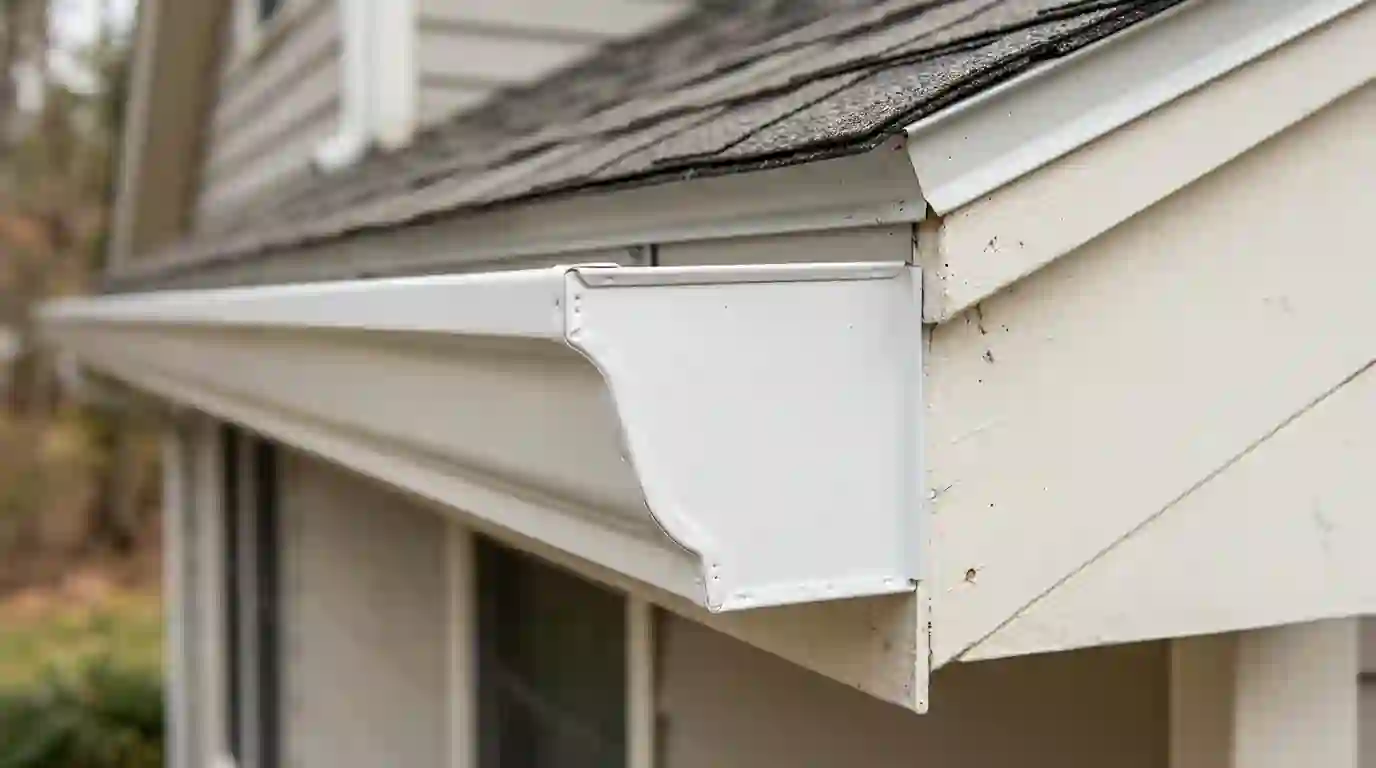
K-style is the gutter profile with a flat back, a flat bottom and a decorative front shaped like crown molding. The 5-inch size is the standard on most single-family homes because it carries the runoff from a typical roof, fits standard 2x3 or 3x4 downspouts, and comes in the widest range of coil colors.
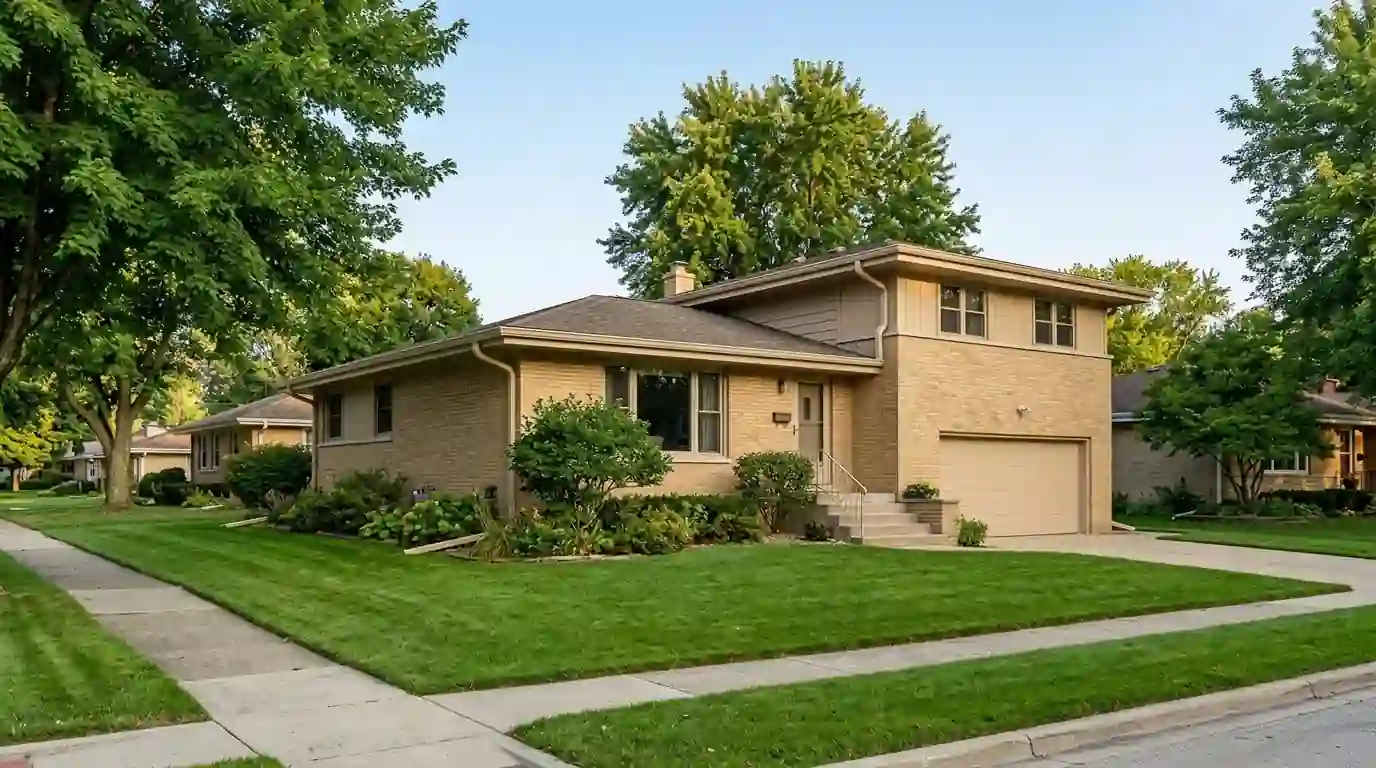
Drive any street in Millard, Keystone or La Vista and almost every gutter you see is a 5-inch K-style. That is not habit. The profile hangs flat against the fascia, holds more water than a half-round of the same width, and looks like trim from the street instead of like a pipe hung on the house.
We roll 5-inch K-style on site from aluminum coil as part of our seamless gutter installation work. This page explains why it fits most houses, how we match it to your trim, and how to tell when a run on your roof needs something bigger.
What the K in K-style means
Seen from the end, the profile looks a little like the letter K: a straight back that sits against the fascia, a flat bottom, and a front face with an ogee curve that steps out and up. That curved face is the part people notice, and it was designed to echo the crown molding on a house.
The flat back is the practical part. It sits tight to the board, so hidden hangers can screw through it into wood, and there is no gap behind the gutter for water to slip into. Half-round gutters, by comparison, need brackets to hold their curved back off the fascia.
Why 5 inch is the default on ranch and two-story homes
Most metro houses built after the war have moderate roof pitches and eaves that collect water from a roof plane of reasonable size. A 5-inch K-style trough handles that runoff with room to spare when it is pitched properly and drains to enough outlets.
Because the K shape has a flat bottom and squared sides, it holds noticeably more water than a 5-inch half-round. That extra capacity is why the profile became the standard for subdivision homes, and why a properly laid out 5-inch system rarely overflows on a ranch or a simple two-story.
- Ranch homes with a single, moderate roof plane
- Split levels and raised ranches with short runs
- Two-story homes without large valleys
- Garages and porches attached to those homes
Color matching to trim and siding
K-style coil is made in more colors than any other profile, which makes matching easy. We bring color samples to the measure and hold them against your fascia and soffit, because a swatch on a screen never looks the same as metal in Nebraska daylight.
The common choice is to match the gutter to the fascia so the two read as one band of trim. Downspouts can match the gutter or the siding behind them. Our gutter color guide has more on how different house styles handle it.
Downspouts that suit a 5-inch run
Standard 2x3 downspouts work on many 5-inch systems, but we often fit 3x4 downspouts with the same gutter. The larger opening drains faster, clogs less with maple seeds and cottonwood fluff, and lets a single outlet handle a longer run.
Where an outlet goes matters as much as its size. Our downspout installation page explains how we place them so they land away from window wells, walks and driveways.
When 5 inch is not enough
Some roof edges simply receive more water than a 5-inch trough can take. Large uninterrupted roof planes, steep pitches that speed water into the gutter, valleys that funnel two roof faces into one corner, and metal roofs that shed fast are the usual culprits.
When a run like that overflows even with clean gutters and good pitch, the fix is a wider trough. Our 6-inch seamless gutters page explains the upgrade. Plenty of houses mix the two: 5-inch on the simple eaves, 6-inch on the one or two runs below the big roof.
What to look for
Signs a 5-inch K-style is the right fit
Typical subdivision home
Ranches, split levels and modest two-story homes with ordinary roof pitches nearly always drain well on 5-inch K-style when outlets are placed sensibly.
Existing gutters rarely overflow
If your current gutters only spill when they are clogged, the size is probably fine and a new seamless K-style run will keep up.
You want many color options
The 5-inch K-style profile is stocked in the broadest range of coil colors, so matching unusual trim or a newer siding shade is straightforward.
Fascia is flat and straight
The flat back of a K-style gutter needs a flat board to hang on, which describes the fascia on most homes built since the 1950s.
Short to medium runs
Eaves under about 40 feet with one outlet, or longer eaves with outlets at both ends, are well within what this size handles.
Budget is a factor
Five-inch coil uses less metal per foot than six-inch, so it is the most economical seamless option for a whole house.
How the job goes
How we lay out a K-style system
- 1
Measure each eave
We measure every roof edge, note the roof area draining to it and look for valleys or upper roofs that send extra water down, which decides the size on each run.
- 2
Choose color and outlets
You pick a color from physical samples held against your trim, and we mark outlet spots together so downspouts land where the yard can take the water.
- 3
Form the runs on site
The roll former shapes 5-inch K-style from coil in the driveway, and each piece is cut to length with end caps and outlets fitted on the ground.
- 4
Hang to a string line
Runs go up on hidden hangers about two feet apart, set to fall toward the outlets so water drains instead of standing in the trough.
- 5
Downspouts and flush test
Downspouts, elbows and extensions are attached, then we run a hose in each gutter to confirm flow before cleaning up the job site.
Pricing
K-style pricing
Most published aluminum gutter prices assume 5-inch K-style, since it is the common residential product. The rows below show installed ranges and a typical whole-house total.
| Item | Published range |
|---|---|
| Aluminum gutters installed, per foot | $10 to $20 per foot |
| Seamless installed, Omaha estimate | $7.67 to $18 per foot |
| Each downspout installed | $30 to $75 per downspout |
| Typical whole-house install | $600 to $4,100 |
National ranges published by HomeGuide, Handoff, Forbes Home. Your price depends on the house; we give you a number on the phone or at the house before any work starts. See the full gutter price guide.
Total footage, the number of corners and downspouts, two-story access and .032 coil push the number up. Our price guide breaks it down.
Omaha conditions
K-style and Omaha housing
Omaha has a deep stock of postwar ranches and split levels, with more than a quarter of the city's homes built between 1940 and 1969. Those houses were designed with straight fascia boards and moderate roofs, which is exactly where a 5-inch K-style gutter does its best work.
The size still has to handle spring and summer storms. May, June and August each average well over four inches of rain here, and a properly pitched 5-inch run with enough outlets moves those cloudbursts off a typical roof without spilling. Where it cannot, we size up that run and leave the rest alone.
Talk to a gutter crew about 5-inch k-style gutters
Tell us what you are seeing at the roof edge. We answer around the clock and give you straight answers on repair or replacement.
FAQ
5-Inch K-Style Gutters questions
What is the difference between K-style and half-round gutters?
K-style has a flat back and bottom with a decorative curved front, and it hangs flat against the fascia on hidden hangers. Half-round is a simple semicircle that hangs from brackets. For the same width, K-style holds more water, which is why it is standard on most homes. Half-round suits older and historic houses where its rounded look matches the architecture.
Can I mix 5-inch and 6-inch gutters on one house?
Yes, and it is common. We often run 5-inch K-style on the simple eaves and switch to 6-inch on the one or two runs that collect water from a big roof plane or valley. The profiles look nearly the same from the ground, especially in the same color. Where the two sizes meet at a corner, we fit a transition so the joint stays watertight.
Will a 5-inch K-style gutter handle a heavy Omaha thunderstorm?
On a typical ranch or two-story roof, yes, as long as it is pitched toward its outlets and has enough downspouts. Problems usually come from too few outlets, clogged elbows or a valley dumping into one spot. If water still pours over a clean, well-pitched run in a normal storm, that run needs a wider gutter or an extra downspout.
How do I pick a K-style gutter color that will not look wrong in a few years?
Match the gutter to your fascia or trim, not to the roof, since trim tends to stay the same color through siding and roof changes. Look at physical samples outdoors at different times of day. Neutral shades such as white, almond, clay and dark bronze age well because the baked-on finish fades evenly and does not draw attention.
Are 3x4 downspouts worth it on a 5-inch gutter?
Often, yes. A 3x4 downspout drains faster than a 2x3 and is less likely to clog with seeds and fluff, which matters under silver maples and cottonwoods. It also lets one outlet handle a longer run. The larger downspout costs a little more and is more visible, so on a short porch run a 2x3 may still be the better-looking choice.
Related gutter services
Checking costs? The gutter price guide lists published ranges, the gutter size calculator estimates 5 or 6 inch and downspout count, and the cleaning schedule planner shows how often your trees fill the gutters.