Specialty gutter work
Built-In Box Gutter Repair and Relining in Omaha
Brown stains creeping across the soffit, paint blistering under the eave, a ceiling spot in an upstairs closet. On an older house, the gutter you cannot see is usually the one leaking.
- Phone answered 24/7
- Our own crews
- Measured and priced on site
 Omaha, Nebraska
Quick answer
A built-in box gutter, sometimes called a Yankee gutter, is a wooden trough framed into the cornice and lined with metal. When the lining cracks or the wood rots, water soaks the walls and ceilings below. We open, dry, repair and reline these gutters, or convert them in a way that keeps the original roofline intact.
Box gutters were standard on better houses built before about 1940. The carpenter framed a channel into the eave, the tinsmith lined it with terne or copper, and the outside face blended into the crown molding so no gutter showed at all. Ignored, they hold water against framing for years before anyone notices.
We see them most in Dundee, Field Club, Hanscom Park, Benson and the Cathedral area, where homes from the 1890s through the 1920s still carry their original cornices. A lot of the trouble we find is not the original lining but a later patch: tar slathered over a crack, or rolled roofing tacked in without proper laps. Those fixes trap water, and rot spreads underneath.
How a box gutter is put together
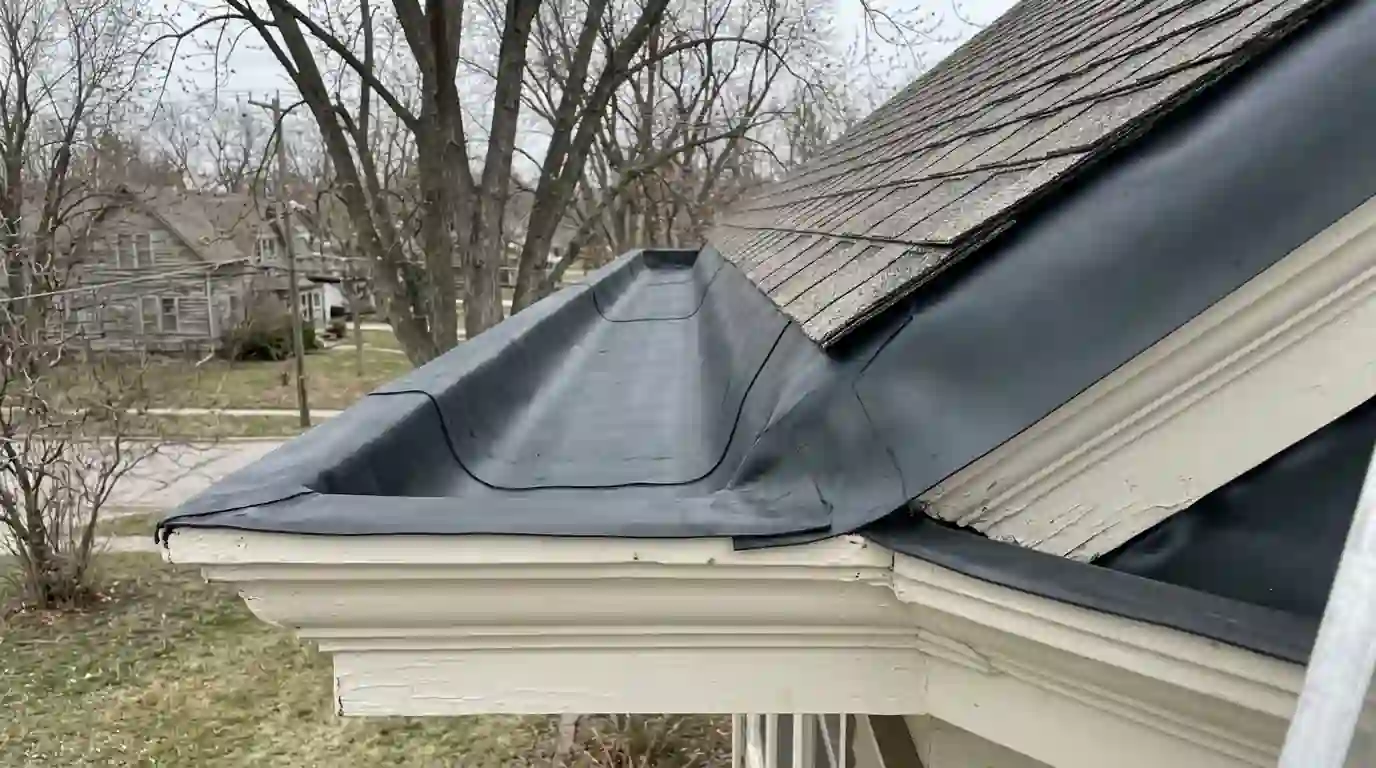
Picture a long wooden box sitting on top of the rafter tails, with a sloped bottom board, a back wall tied to the roof deck and a front wall that doubles as trim. Inside sits a sheet metal or membrane liner that has to lap up under the shingles at the back and over the front edge so water never touches wood. Outlets drop through the bottom into a downspout, often at a conductor head.
Every one of those joints is a place for water to find wood. The weak points we check first are the outlet tubes, the back lap under the roofing, inside corners, and any spot where the liner was nailed through instead of cleated.
What goes wrong first
Old terne-coated steel liners rust from the inside once their paint fails. Copper liners last longer but can crack at soldered seams after enough expansion cycles. Membrane relines from the 1980s and 1990s often shrink and pull away at the ends.
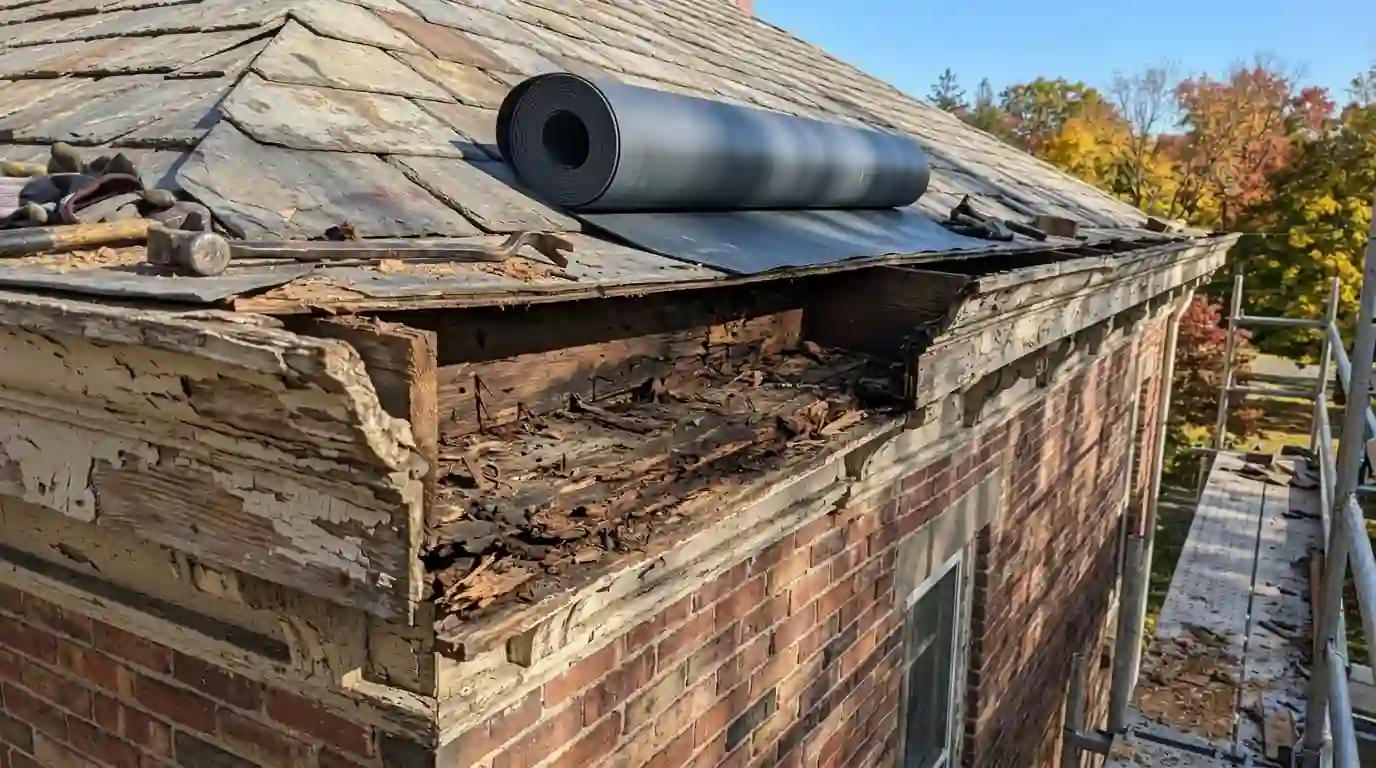
The real damage happens behind the liner. Water that slips through a pinhole wicks into the bottom board, then into the rafter tails and wall plate. By the time paint peels on the crown molding, the board inside may be soft enough to push a screwdriver through.
Relining options we use
Most repairs start with stripping the old liner and opening up rotted sections. We cut out soft wood, sister or replace the bottom board and rafter tails as needed, and rebuild the slope toward the outlets so water does not pond.
For the new liner, a fully adhered membrane designed for low-slope roofing is the most common choice. It forms around corners in one piece, laps under the roofing at the back and wraps over the front edge. Soldered sheet metal, copper or coated steel, is the traditional option and still the longest lasting when it is done with proper expansion joints.
Whichever liner goes in, a new flanged outlet is set into it and the downspout below is checked, because a new liner over a clogged outlet just fails faster. If the conductor head or downspouts are past saving, our downspout installation work covers replacements.
Converting a box gutter without losing the look
Some owners decide the upkeep is not worth it. The usual conversion is to flash over the old trough so it sheds water onto the roof edge, then hang a new gutter on the face of the cornice. Done carelessly, that buries the crown molding behind a big K-style gutter and changes the whole front of the house.
Done with care, it can look almost original. A half-round gutter on low-profile brackets sits close to the trim, and on some cornices a K-style in a color matched to the molding nearly disappears. A converted cornice is hard to undo, so we talk it through first.
Upkeep that keeps a box gutter alive
Box gutters are less forgiving of debris than hanging gutters. A wet mat of leaves sits against the liner and holds moisture right where seams are. Twice-a-year gutter cleaning matters even more here, plus a look at the outlets after big storms.
Coated metal liners need interior paint every several years, and membrane liners need their end laps checked. Both cost far less than a rotted cornice.
What to look for
Signs a box gutter needs attention
Stains on the soffit
Brown or gray streaks across the underside of the eave usually mean water is passing through the liner and the bottom board before dripping out.
Peeling crown molding paint
Paint that blisters or flakes on the cornice trim, even after a fresh coat, points to moisture moving out from inside the gutter box.
Water inside top-floor walls
Damp plaster near the ceiling of an upstairs room or closet along an exterior wall often traces back to a failed box gutter above.
Ponding after rain stops
If water still sits in the trough a day after a storm, the bottom has sagged or the outlet is partly blocked, and the liner is under stress.
Tar patches everywhere
Layers of black patching compound mean past leaks were covered instead of fixed, and the wood under them is often already soft.
Icicles behind the trim
Ice hanging from the soffit rather than the gutter edge means meltwater is escaping behind the liner and running through the cornice framing.
How the job goes
How a box gutter repair goes
- 1
Inspect and probe the wood
We clean out the trough, look at every seam and outlet, and probe the bottom board, rafter ends and fascia so the scope is clear before any liner comes up.
- 2
Strip the old liner
Failed metal, membrane and tar patches come out, along with nails that pierced the bottom. We photograph what we find so you can see the condition of the framing.
- 3
Rebuild the wood and slope
Rotted sections are cut out and replaced with matched lumber, and the bottom is shimmed to a steady fall toward each outlet so water no longer sits in low spots.
- 4
Install the new liner
Membrane or soldered metal goes in with laps under the roofing at the back and over the front edge, and new outlet flanges are sealed into the liner.
- 5
Flush and check downspouts
We run water through the gutter to confirm it drains fully, clear and test each downspout and conductor head, and touch up exterior trim where it was disturbed.
Pricing
What box gutter repair costs
Built-in gutters take more labor than hanging gutters because the trough is part of the house. The ranges below are national figures from published sources.
| Item | Published range |
|---|---|
| Box gutter repair or relining | $20 to $50 per foot |
| Fascia and soffit repair under the cornice | $6 to $20 per foot |
| Seamless aluminum gutters, if converting | $10 to $20 per foot |
National ranges published by HomeAdvisor, HomeGuide. Your price depends on the house; we give you a number on the phone or at the house before any work starts. See the full gutter price guide.
The amount of rotted wood we find is the biggest variable, followed by liner type, roof height and how much trim has to be removed and reinstalled. See our price guide for more.
Omaha conditions
Box gutters and Omaha winters
Nearly half of Omaha's homes went up before 1970, and close to a fifth predate 1940, which is roughly the era when built-in gutters fell out of use. Neighborhoods like Hanscom Park grew through the 1890s, and houses in Field Club still show their 1910s woodwork. Plenty of those cornices still hold their original troughs.
Our winters are the hard part. January lows average in the mid teens, and the state now sees more midwinter thaws lasting several days. Snow melts into the box by day and freezes by night, and ice expanding against a liner opens seams that were fine in the fall. A check before winter, and a careful look after the first thaw, catches most of it. The guide to box gutters goes deeper on history and upkeep.
Talk to a gutter crew about built-in box gutter repair
Tell us what you are seeing at the roof edge. We answer around the clock and give you straight answers on repair or replacement.
FAQ
Built-In Box Gutter Repair questions
Is relining better than converting to hanging gutters?
If the cornice framing is sound and you value the original look, relining is usually the better choice. It keeps the roofline clean and lasts many years with basic upkeep. Conversion makes sense when the framing is badly rotted, when the house has already lost most of its trim detail, or when the owner wants lower upkeep. We show you photos of the inside of the trough before you decide.
How do I know if my house has built-in gutters?
Look at the eave from the yard. If you see no gutter but the trim has a deep crown molding and downspouts drop from the cornice itself, you likely have box gutters. From a window on the top floor you may see the trough lining just above the roof edge. Many homes in older Omaha neighborhoods built before 1940 still have them, sometimes hidden under later aluminum trim.
Can you repair just one leaking section of a box gutter?
Often, yes. A failed outlet, a split inside corner or a short section of rotted bottom board can be repaired on its own, with the new liner lapped and sealed into the old. The catch is that liners usually wear out at the same rate, so a spot repair on a very old liner may buy only a few seasons.
Will relining the box gutter change how my house looks?
No. A reline happens inside the trough, which is not visible from the street. The crown molding and fascia stay as they are, apart from any boards that were rotted and had to be replaced with matching profiles. After painting, the cornice should look the same as it did, only without the stains and peeling paint that sent you looking for a repair.
Why does my box gutter leak only in winter or early spring?
Ice is the usual reason. Snow sits in the trough, melts during the day and refreezes at night, and the ice can climb above the back lap of the liner or push against weak seams. Meltwater then runs behind the lining. A gutter that seems tight in summer storms can still fail this way, which is why we look closely at the back lap and the outlet during any winter leak call.
Related gutter services
Checking costs? The gutter price guide lists published ranges, the gutter size calculator estimates 5 or 6 inch and downspout count, and the cleaning schedule planner shows how often your trees fill the gutters.