Gutter repair
Sagging Gutter Repair in Omaha, NE
A gutter that dips between hangers or leans away from the fascia is losing its grip on the house, and every rain pours over the low spot instead of reaching the downspout.
- Phone answered 24/7
- Our own crews
- Measured and priced on site
 Omaha, Nebraska
Quick answer
Sagging gutter repair means pulling a drooping run back to its correct line and fastening it with new hidden hangers driven into solid framing. You need it when you see a belly in the gutter, a gap behind it, spikes working loose, or water spilling over one section while the rest of the run stays dry.
Most sags in Omaha start small. One old spike backs out a quarter inch, the gutter tips forward, water and debris collect in the low spot, and the added weight pulls the next fastener loose. By the time the run looks wavy from the street, several hangers have usually given up.
Our repair is about what the gutter hangs on, not just the gutter. We check whether the fascia behind it is sound, whether the old fasteners ever reached a rafter tail, and whether the run still has fall toward its outlet. If it lost that fall, re-pitching happens in the same visit, so the fix holds through the next snow load and not just the next dry week.
Why gutters pull away from the house
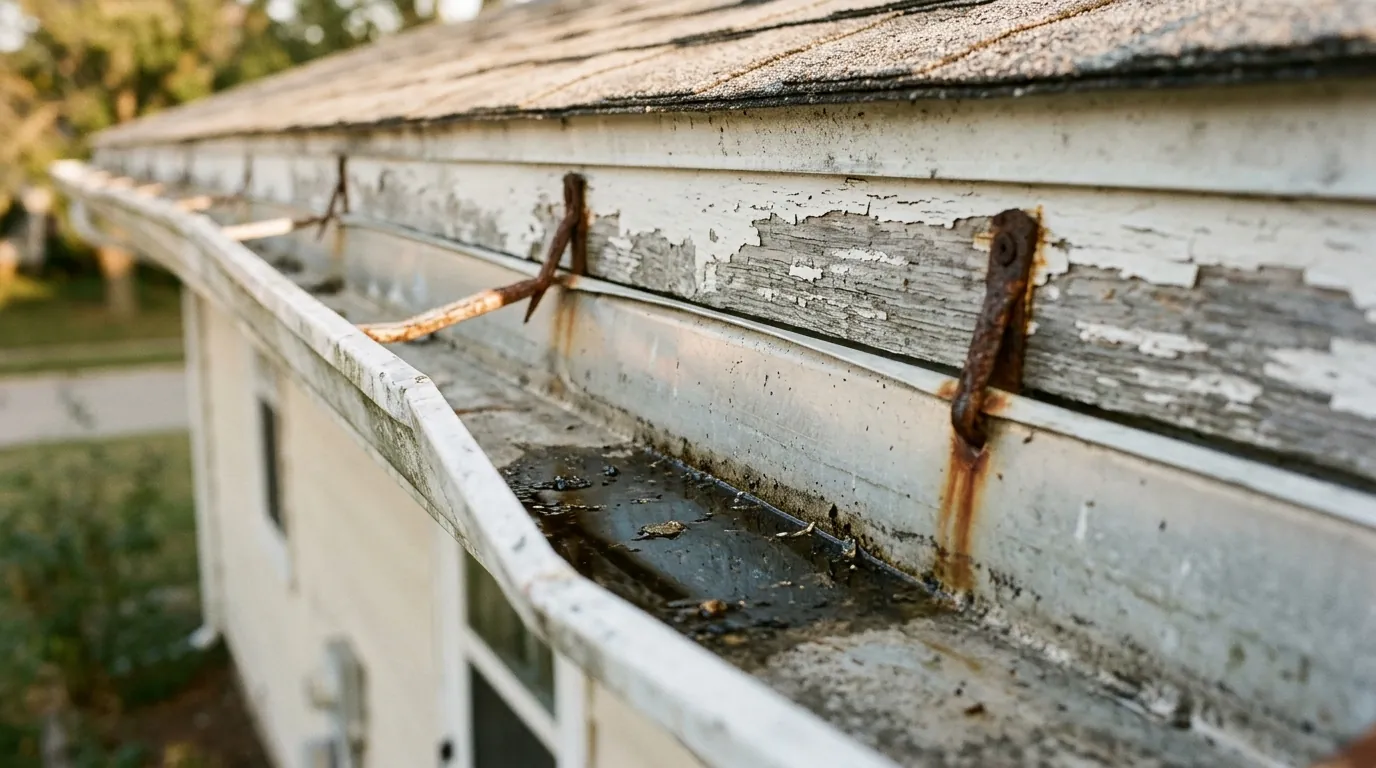
The old spike and ferrule system is the most common culprit we find on homes built before the 1990s. A long nail goes through the front lip, through a metal sleeve and into the fascia. Every summer heat cycle and winter freeze nudges that nail outward a little, and after enough years the hole is oval and the spike is doing nothing.
Other causes tend to stack on top of loose spikes, and a sag usually has two or three of them working together.
- Rotted fascia that no longer holds a screw, often from water running behind the gutter for years
- Snow and ice sitting in the trough for weeks, which multiplies the load on each hanger
- Ladders leaned against the front edge during painting, roofing or holiday light season
- Packed, soaked debris that turns a light aluminum trough into a heavy one
- Hangers spaced too far apart when the gutters were first hung
Hidden hangers and where the screws go
We replace failing spikes with hidden hangers, the clip style that sits inside the gutter under the front lip and fastens through the back wall. On eastern Nebraska homes we space them about every 24 inches, and closer, around 16 to 18 inches, on runs under steep roof planes or anywhere snow tends to pile up.
Spacing only matters if the screw lands in something solid. Where we can, we line hangers up with the rafter tails behind the fascia so the screw bites framing instead of a single board. On homes where the tails are irregular, we use longer screws and more hangers rather than trusting a thin fascia alone.
Checking the fascia before we re-hang
A gutter can only be as secure as the board behind it. Before re-hanging, we pull the sagging section back and probe the fascia with an awl along the line where the hangers will go. Soft, dark or crumbling wood means a new hanger would strip out within a season.
If the rot is local, we cut out the bad length and replace it during the same visit, then wrap it in aluminum trim coil if the rest of the house is wrapped. Wider damage is a fascia board replacement job, and we will tell you plainly which one you are looking at.
When a sag is really a replacement problem
Re-hanging works on gutters that are straight, sealed and reasonably thick. It does not make sense on a sectional system that leaks at every joint, on thin aluminum that has kinked at the sag point, or on runs crushed by ice. Bent metal remembers its bend, and a new hanger only hides it for a while.
In those cases, we will show you the kink or the split and price a new run alongside the repair. A one-piece run from our seamless gutter installation crew, formed from .032 coil, often costs less over time than re-hanging a tired system twice.
What to look for
Signs your gutters are sagging
A visible belly in the run
Sight down the gutter from one end. A smooth line should fall gently toward the outlet, not dip and rise between hangers like a hammock.
Gap behind the gutter
Daylight between the back of the gutter and the fascia means water from the roof edge is dropping behind the gutter and onto the wood.
Spike heads standing proud
Old spikes that stick out from the front lip a quarter inch or more have backed out of the fascia and are no longer carrying any load.
Water over one section only
If rain sheets off the front edge in one spot while the rest of the gutter drains normally, that low spot has dropped below the outlet.
Stains or rot on fascia
Dark streaks, peeling paint or soft wood directly under a section of gutter point to water getting behind it for a long time.
Bent hangers after winter
Hangers twisted forward or pulled out of shape after a heavy snow mean the run took more weight than its fastening could hold.
How the job goes
How we fix a sagging gutter
- 1
Look at the whole run
We walk the full length of the sagging gutter and the runs beside it, sighting the line, checking outlets and marking every loose spike or failed hanger we find.
- 2
Clear the trough
Debris and standing water come out first. A clean gutter is lighter to lift and lets us see seams, outlet joints and any corrosion hiding under the muck.
- 3
Probe and fix the fascia
We lift the low section back and test the wood behind it. Any soft length gets cut out and replaced before a single new hanger goes in.
- 4
Re-hang to a pitched line
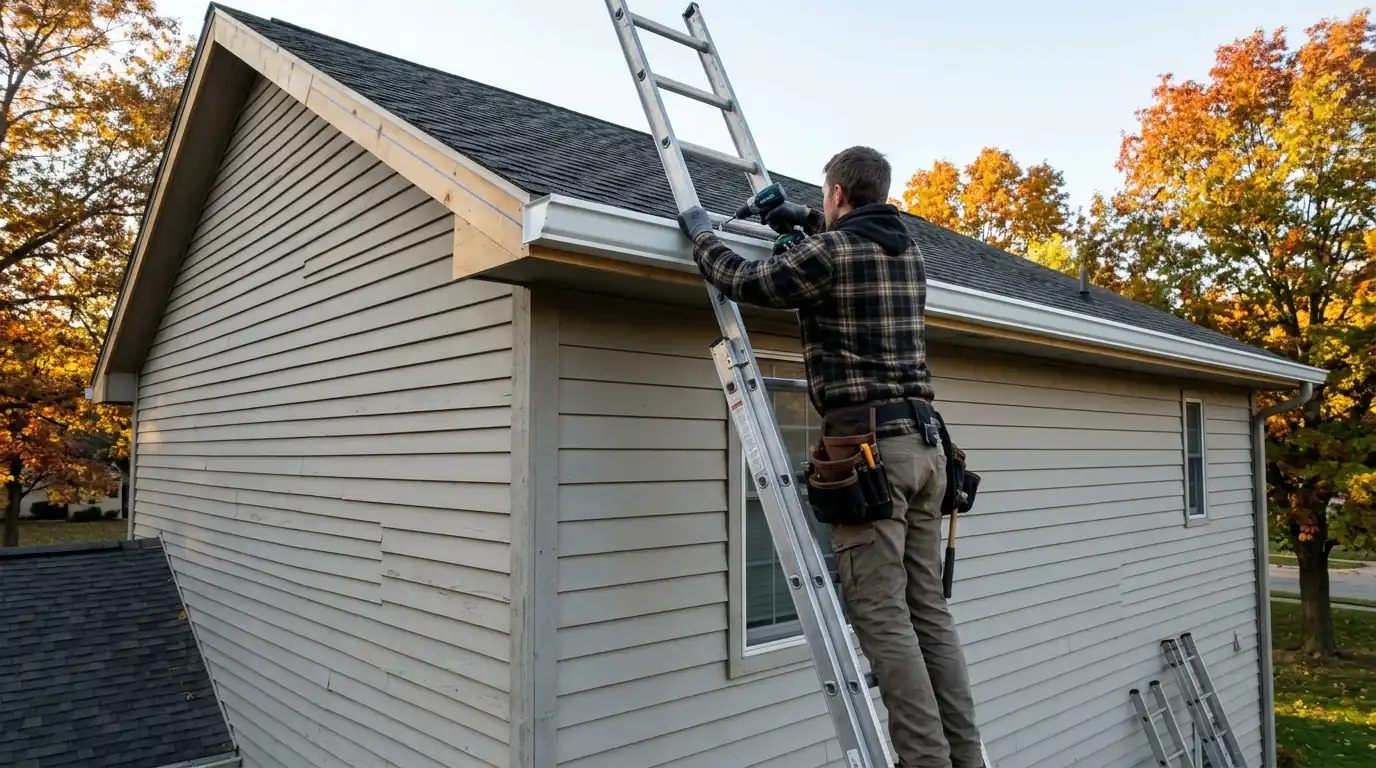
We snap a line with the correct fall toward the outlet, lift the gutter to it and fasten new hidden hangers into framing, filling the old spike holes.
- 5
Flush and confirm
We run water from the high end and watch it travel to the downspout. Any remaining low spot or slow outlet gets adjusted before we pack up.
Pricing
What sagging gutter repair costs
Most sag repairs fall into the small repair range because the gutter itself is reusable. The price climbs when new hangers must go in along a long run or when fascia has to be replaced first.
| Item | Published range |
|---|---|
| Minor sag or pitch fix | $75 to $300 |
| Typical gutter repair visit | $100 to $450 |
| Fascia board replacement, if rotted (per foot) | $7 to $40 per foot |
National ranges published by HomeGuide, This Old House. Your price depends on the house; we give you a number on the phone or at the house before any work starts. See the full gutter price guide.
Run length, second story access and how much soft fascia we uncover move the price most. See our price guide for the full table.
Omaha conditions
Omaha snow, old fascia and sagging gutters
Omaha averages about 27 inches of snow a year, and much of it sits on the roof edge after a storm, melts by day and refreezes in the gutter at night. That cycle is hard on fasteners, and it is why we space hangers tighter here than a crew in a mild climate would.
Age is the other factor. Nearly half the city's homes went up before 1970, and many of them still carry original fascia boards behind gutters that have been re-spiked more than once. On those houses we expect to find a soft spot or two, and we plan for it rather than discovering it after the gutter is back up.
Talk to a gutter crew about sagging gutter repair
Tell us what you are seeing at the roof edge. We answer around the clock and give you straight answers on repair or replacement.
FAQ
Sagging Gutter Repair questions
Can I just pound the old gutter spikes back in?
You can, and it may hold for a few weeks. The problem is that a spike that worked loose has already enlarged its hole, so hammering it back drives it into wood that no longer grips. It also does nothing about the condition of the fascia behind it. Replacing spikes with screwed hidden hangers is the fix that actually stays put.
How far apart should gutter hangers be on an Omaha house?
We use about 24 inches as the baseline and tighten to roughly 16 to 18 inches under steep roofs, below valleys and on north-facing runs where snow lingers. Those spacings are common trade practice in snow country. Many older installs we see have spikes every 30 inches or more, which is one reason sags show up after a heavy winter.
Will re-hanging a sagging gutter fix the overflow too?
Usually yes, if the overflow came from the sag. Once the low spot is lifted and the run has fall to the outlet, water stops pooling and spilling there. If overflow continues after re-hanging, the cause is often a clogged downspout or a run that needs a second outlet, and we check both during the same visit.
Do you re-hang sagging gutters on the second story?
Yes. Two-story eaves are common across the metro and we bring ladders and standoffs sized for them. The work itself is the same: clear the trough, probe the fascia, re-hang to a line and flush. Height adds setup time and sometimes a second person, so second-story repairs tend to sit higher in the price range than a single-story ranch.
My gutter sags only in winter. Is that a real problem?
It is a warning. A run that drops under ice and springs back in April has hangers flexing past their limit, and each winter weakens them further. Eventually one fails and the section tears loose, sometimes taking fascia with it. Re-hanging with tighter spacing before the next snow costs far less than repairing ice damage afterward.
Related gutter services
Checking costs? The gutter price guide lists published ranges, the gutter size calculator estimates 5 or 6 inch and downspout count, and the cleaning schedule planner shows how often your trees fill the gutters.