Omaha neighborhood we serve
Copper and Half-Round Gutters in Country Club, Omaha, NE 68104
Tudor rooflines are steep, broken by gables and valleys, and close to the eye from the street. Gutters here have to carry hard, fast water and still look like they belong on the house.
Country Club at a glance
- Area
- Country Club, Omaha, NE
- ZIP
- 68104
- County
- Douglas County, NE
- Office
- Omaha office, 516 South 13th Street
- Phone
- Answered 24/7
Quick answer
For Country Club homes we install copper and half-round gutters, fix overshoot at roof valleys, and size runs for steep Tudor roof planes. Each job starts with a look at the valleys, the brackets and where water lands at the foundation. Our crews work out of the downtown Omaha office, a few miles east. Call us to talk through options.
Country Club was platted in 1926 as a planned community, and building there wrapped up by 1949, so nearly every house falls inside that short stretch of years. The result is an Omaha neighborhood with a consistent look: many Tudor style houses, brick and stucco walls, steep gables and slate or shingle roofs that drop to low eaves.
That consistency makes gutters stand out when they are wrong. A bulky K-style run on a curved Tudor eave, or a white downspout cutting across a brick chimney wall, draws the eye on these blocks. Most of our work here is either restoring a period look with copper gutters or quietly fixing the drainage problems that steep roofs create.
Steep Tudor roofs and what they do to water
A steep roof sheds water faster than a low-slope ranch roof, and on a Tudor the water rarely comes off evenly. Gables shorten some eaves and lengthen others, and cross-gables form valleys that gather two roof planes into one narrow channel. When that channel empties at an inside corner, water hits the gutter with enough speed to jump the front lip. A valley splash guard at that corner, and sometimes a wider trough, keeps it in.
Half-round gutters suit the low, rounded eaves of these houses and sit well with exposed brackets. Copper is the material many owners pick for front elevations because it matches the brick and weathers to a brown, then green, patina. We solder copper seams rather than relying on sealant, and we never mix copper with aluminum or galvanized straps, since the contact corrodes the cheaper metal quickly.
Hail, ice and mature trees on short eaves
Nebraska ranks at the top of national hail risk, and soft copper does dent in a bad storm, though it rarely splits. Those dents tend to read as character on a weathered patina, which is part of why owners here accept the tradeoff. Steep north slopes on Tudors also hold snow, and January lows in Omaha average in the mid teens, so ice can build at short eaves where meltwater refreezes. We set brackets closer together on those runs.
The neighborhood's mature trees drop leaves and seeds into valleys first, where they form small dams. Clearing the valleys matters as much as clearing the gutter itself.
Most called jobs here
Where we spend our time in Country Club
Copper Gutters
Soldered copper suits brick and stucco Tudor fronts and weathers rather than fades. We use copper downspouts, straps and fasteners throughout so no dissimilar metal touches the system.
More on this serviceHalf-Round Gutters
The rounded profile on exposed brackets fits the period eaves here. Round downspouts finish the look, and we can do it in copper, aluminum or steel to suit the budget.
More on this serviceValley Splash Guards
Cross-gables send concentrated water out of valleys at inside corners. A splash guard turns that stream back into the trough instead of over the front onto the walk.
More on this service6-Inch Seamless Gutters
Where a steep main roof drains into one long rear run, a wider trough and 3x4 downspouts handle summer downpours that a standard five inch gutter cannot keep up with.
More on this serviceIce Dam Gutter Repair
Shaded north slopes hold snow, and meltwater refreezes at short eaves. We repair bent brackets and split seams after thaw and tighten bracket spacing on problem runs.
More on this serviceRain Chains
At a front entry or garden patio with a small roof above it, a copper rain chain can replace a downspout and suit the house, as long as the roof area feeding it stays small.
More on this service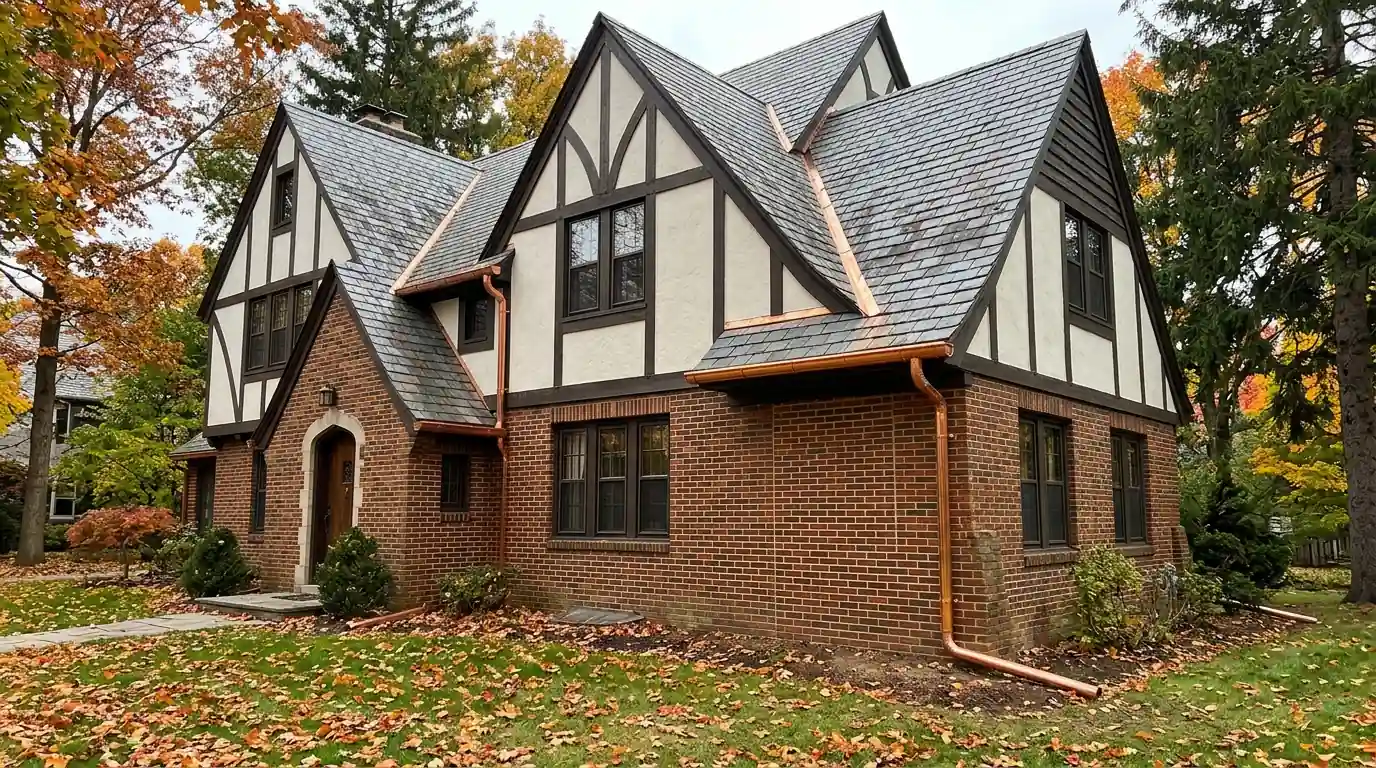
Finding your way around Country Club
The Country Club Historic District covers about 27 blocks from 50th to 56th streets, between Northwest Radial Highway and Happy Hollow Boulevard, and it joined the National Register at the end of 2004. Dundee lies just to the south and Benson to the northwest, both neighborhoods where we see a similar run of older rooflines. Most Country Club homes use the 68104 ZIP code.
Gutter work in Country Club, answered any hour
Call for seamless gutters, repairs, guards or a clean-out. We talk through the job on the phone and set a time to measure.
FAQ
Gutter questions from Country Club
Is copper worth it on a Country Club Tudor?
On a brick or stucco Tudor, copper often looks like it came with the house, and it lasts a long time without paint. It costs well above aluminum, so many owners use it on the street facing runs and choose painted half-round aluminum at the back. We can price both ways so you can compare, and our price guide shows typical ranges.
Why does water shoot over my gutter at the inside corner of a gable?
That corner is where a roof valley empties. Two roof planes funnel into the valley, and on a steep Tudor the water leaves it fast enough to clear the gutter lip. A splash guard or diverter at the corner fixes most cases. If the run also overflows along its length, a wider gutter and larger downspout may be needed.
Will a new copper gutter turn green right away?
No. New copper is bright, then darkens to brown within months as it weathers. The green patina takes many years outdoors and forms unevenly, first on surfaces that hold moisture. Some owners like the bright stage, others prefer it brown. We do not apply coatings to speed or stop the process unless you ask.
Can you match half-round gutters to the existing brackets on my house?
Often, yes. If the original brackets are sound and spaced closely enough, we can hang new half-round in them after checking pitch. If they are rusted, bent or set too far apart for snow loads, we replace them with new brackets in a matching profile and finish so the eave still looks the same from the street.