Gutter guide
Cottonwood Season and Your Gutters in Omaha
Every late spring the air over Omaha fills with white fluff, and a week later plenty of gutters stop draining. Here is what cottonwood season does to a gutter system and how to stay ahead of it.
By Agatha Prewitt, Gutter Guides EditorUpdated
The short answer
Cottonwood fluff is light, wet-mats into a felt layer and slides into downspout elbows, where it packs tight. Because it drops in late spring, right before the wettest weeks of the year, the safest plan is to clean after the drift ends, not before. Flush every downspout, check the outlets, and consider fine micro-mesh guards if a cottonwood or silver maple hangs over the roof.
Call (402) 395-0908Why fluff behaves differently from leaves
Nebraska made the eastern cottonwood its state tree in 1972, and the metro is full of them along creeks, drainage ways and older lots. In late spring the female trees let go of their cottony seed, and it drifts through neighborhoods thick enough to look like a snow squall. You do not need a cottonwood in your own yard to catch it. A tree three lots over is close enough.
A dry leaf sits on top of the water and eventually floats toward the outlet. Fluff does the opposite. The first rain soaks it, it collapses into a gray felt, and that felt grabs shingle grit and pollen until it turns into something close to a wet sponge lying in the trough.
The worst part happens out of sight. Water carries clumps of that felt down the outlet, and the first elbow catches them. Each storm adds another plug behind the first, until the downspout is packed solid from the bend up.
The timing lands right before the heavy rain
May is the wettest month of the year in Omaha, averaging about 4.66 inches, and June is not far behind. That puts the fluff drop and the first big thunderstorms in the same few weeks. A gutter you cleaned in April can be clogged by Memorial Day without you ever seeing it happen.
When a packed downspout meets a summer downpour, the water has nowhere to go but over the front lip. It lands next to the foundation, splashes mud onto siding and soaks the soil right where the basement wall is. That is why we treat cottonwood season as a drainage problem first and a tidiness problem second.

Silver maple seeds make the mat stronger
Silver maple is the other tree that keeps gutters busy in late spring. It was planted all over Nebraska cities as a yard and street tree, and it sets heavy seed crops at about the same time the cottonwoods shed. The Nebraska Forest Service specifically notes that its winged seeds clog gutters.
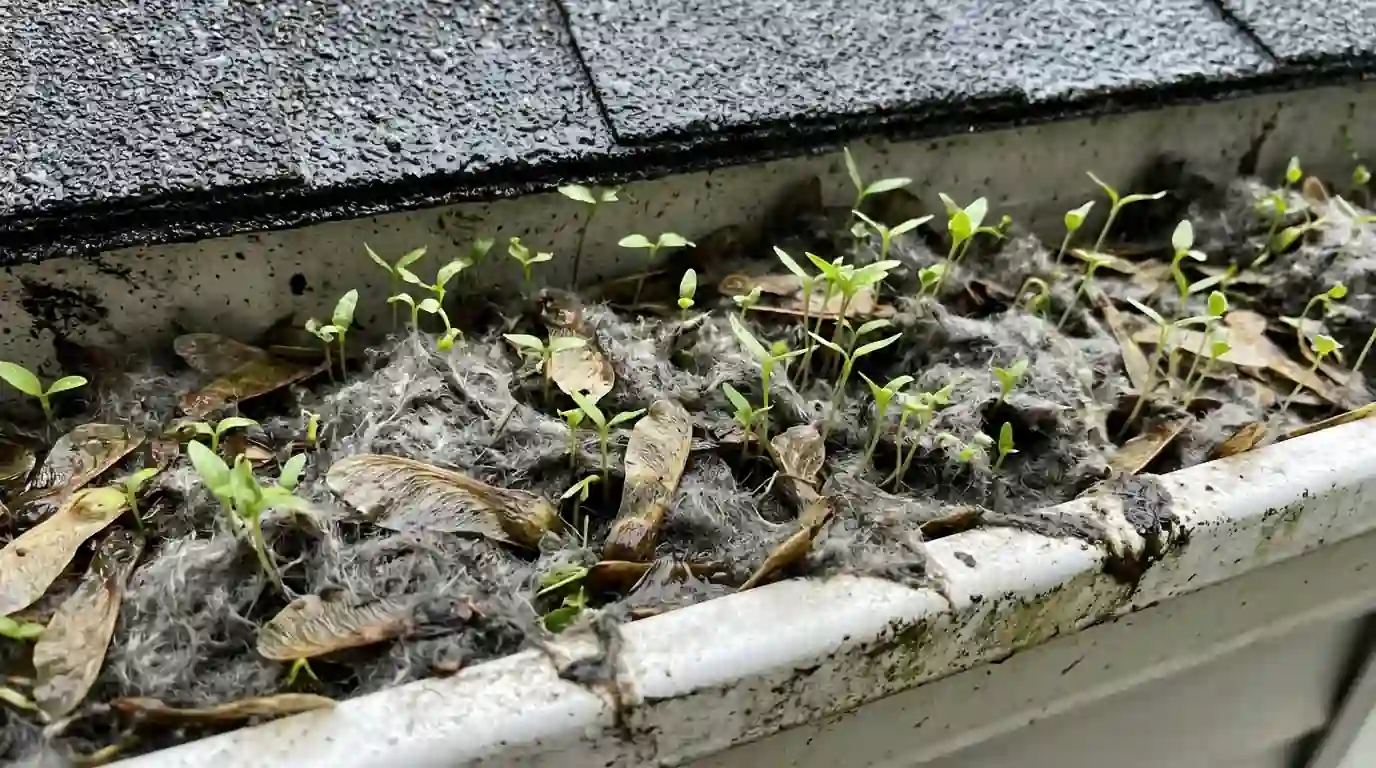
On their own, the helicopters are a nuisance. Mixed with fluff they act like rebar in concrete, giving the mat structure so it holds together in the outlet instead of breaking up. Leave that mix in place for a few weeks of warm, wet weather and you will often find seedlings rooting in the gutter itself.
What to look for once the drift stops
You can learn a lot from the ground with a pair of binoculars and the next rain. Walk the house during a steady shower and watch where water leaves the system. Healthy gutters send it out of the downspouts in a strong stream. Clogged ones give you these clues:
- Water spilling over the front lip near a downspout outlet, which points to a plug at the elbow
- A weak dribble at the bottom of a downspout during a hard rain
- Small green sprouts standing up along the gutter edge
- Dark streaks or tiger striping on the gutter face from repeated overflow
- A trench or bare patch in the mulch bed under one section
- Standing water in the trough a day after the storm has passed
Matching the clean-out to the trees overhead
Nebraska Extension recommends cleaning gutters and downspouts twice a year, and that is a fair baseline for most houses. Under cottonwoods and silver maples, the spring visit should come after the seed has finished falling, usually early summer. Cleaning in April feels responsible, but it leaves you open for the exact weeks that cause trouble.
The second visit belongs after fall leaf drop. Homes under several big trees sometimes need a third pass, and a seasonal maintenance plan keeps that on the calendar without you tracking it. Our cleaning schedule tool can help you sort out which group your house falls into.
| Debris | When it lands | What it does in the gutter | Best response |
|---|---|---|---|
| Cottonwood fluff | Late spring | Mats into felt, packs elbows | Clean after the drift, flush every downspout |
| Silver maple seeds | Late spring | Binds the mat, sprouts in place | Hand clean, check outlets for plugs |
| Oak and maple leaves | Fall | Piles in corners and outlets | Clean after leaf drop, before freeze |
| Honeylocust leaflets | Late summer into fall | Fine bits wash into downspouts | Flush downspouts during the fall visit |
Guards and cottonwood fluff
Coarse screens and drop-in vinyl covers do little against cottonwood. The fluff passes right through the openings or sits on top in a blanket that sheds rain over the edge. If a cottonwood is close, the guard that actually stops it is fine stainless mesh stretched over a rigid frame.
Even micro-mesh guards are not a set-and-forget answer. Fluff collects on the top surface and can mat there during a wet week, so it needs a brush or a rinse once the season ends. That is far easier than scooping a full trough, but it is still upkeep. Our guide to gutter guards walks through when the cost pays off.
| Item | Published range |
|---|---|
| Cleaning, single-story home | $70 to $200 |
| Cleaning, two-story home | $100 to $275 |
| Clearing clogged downspouts | $60 to $150 |
| Micro-mesh guards installed | $40.50 per foot |
National ranges published by HomeGuide, This Old House. Your price depends on the house; we give you a number on the phone or at the house before any work starts. See the full gutter price guide.
Doing it yourself, and when to call us
On a single-story ranch with a sturdy ladder and good footing, a homeowner can scoop the trough by hand, bag the debris and run a garden hose into each outlet. If the water backs up instead of running free, the plug is at the elbow. Pull the lower section off, clear it from below and reattach it with new screws.
Skip the pressure washer. It drives wet fluff deeper into the downspout and can force water under the first course of shingles. Two-story homes, steep roofs and buried drain lines are where a crew earns its keep, both for safety and because clearing packed downspouts sometimes means cutting into an underground line.
If you would rather hand the whole season off, give us a call. Our gutter cleaning visits include hand removal, flushing every downspout and a look at hangers and seams while we are up there. See the price table below for typical ranges.
Agatha Prewitt, Gutter Guides Editor
Writes the gutter guides for Hastings Seamless Gutters, drawing on what our crews see on Omaha roofs through hail season, cottonwood season and winter.
FAQ
Questions readers ask
Can cottonwood fluff clog my gutters if no cottonwood grows on my lot?
Yes. The seed fluff is built to travel on the wind, and it drifts across whole neighborhoods in late spring. A single large tree along a creek or a few lots away can coat roofs on an entire block. If you see fluff collecting against your fence or in the window screens, assume some of it has landed in your gutters as well.
Should the spring gutter clean happen before or after the cottonwood drift?
After. If you clean in April, the fluff and silver maple seed arrive a few weeks later and you start the rainy season with gutters already filling up. Waiting until the drift has visibly ended, usually early summer, means one visit removes the whole spring load. If you only clean once in spring, that timing makes the most difference.
Why does water pour over the gutter right next to the downspout?
That pattern almost always means the downspout is plugged, most often at the first elbow below the outlet. Water reaches the outlet, cannot drop, and spills over the lip closest to it. In late spring the plug is usually a wad of wet cottonwood fluff mixed with maple seeds. Clearing the elbow and flushing the full length of the downspout normally fixes it.
Will a basic gutter screen keep cottonwood fluff out?
Not well. Standard screens are sized to block leaves and twigs, and cottonwood fluff either slips through the holes or blankets the top of the screen and sends rain over the edge. Fine stainless micro-mesh is the type that actually stops fluff, and even that needs its top surface brushed or rinsed once the season ends.
Questions about your own gutters?
Call and describe what you are seeing. The line is answered 24/7 and a crew can come out to measure.