Gutter guide
Are Gutter Guards Worth It Under Nebraska Trees?
Gutter guards are sold as the end of gutter cleaning. They are not, but the right guard on the right house can cut the work down to a light brushing. Whether they are worth it depends on the trees over your roof.
By Agatha Prewitt, Gutter Guides EditorUpdated
The short answer
Guards pay off when big trees hang over the roof, the house is two stories or steep, and you are cleaning more than twice a year. Under cottonwoods and silver maples, only fine stainless micro-mesh really stops the debris. Under mostly oak and maple leaves, a rigid perforated screen can be enough. On a ranch with few trees nearby, two cleanings a year usually costs less than guards.
Call (402) 395-0908Start with the trees, not the product
Every guard is a filter, and filters are sized to what they need to catch. Before comparing products, look up and figure out what actually lands on your roof. In the Omaha area the usual suspects are cottonwood fluff and silver maple seeds in late spring, then oak, maple and honeylocust leaves in fall, plus pine needles on some lots.
Tree canopy covers about 27 percent of Omaha, but it is not spread evenly. Older neighborhoods with mature street trees may sit under a near-continuous canopy, while newer subdivisions on the edge of the metro have young trees that barely reach the eaves. Two houses a mile apart can need completely different answers.
Spend a week of each season noting what you find on the driveway, in window wells and along the edge of the roof. Fine leaflets from honeylocust, a common street tree because it handles tight root space and poor soil, wash through most screens and settle in downspout elbows. Needles from a spruce or pine wedge into perforations. That short inventory tells you more about the right guard than any brochure will.
The main guard types and what they stop
Guards fall into a few families. Each handles some debris well and some poorly, which is why a neighbor's glowing review may not apply to your house.
| Guard type | Good at stopping | Weak against | Typical upkeep |
|---|---|---|---|
| Stainless micro-mesh | Cottonwood fluff, seeds, pine needles, grit | Mats of fluff on top during wet weeks | Brush or rinse the top surface |
| Rigid perforated aluminum | Oak and maple leaves, twigs | Fluff and small seeds pass through | Occasional clean-out underneath |
| Reverse curve | Large leaves | Heavy downpours can overshoot | Clean the nose and slot |
| Foam inserts | Large leaves | Seeds sprout in the foam, holds moisture | Replace every few years |
| Brush inserts | Large leaves and sticks | Seeds and fluff tangle in bristles | Pull and shake out |
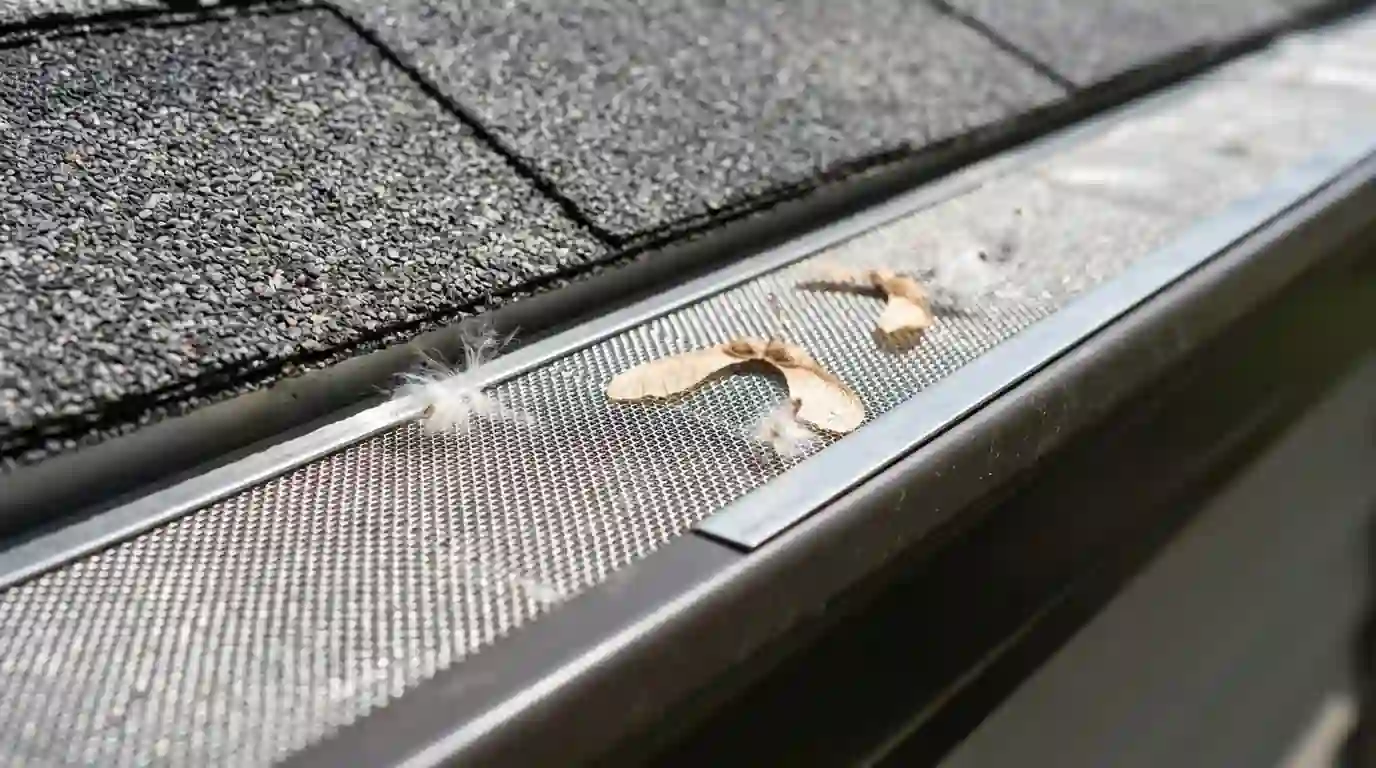
Cottonwood and silver maple: why micro-mesh wins
Eastern cottonwood, the state tree, drops its cottony seed in late spring in clouds that drift across whole neighborhoods. Silver maple sheds heavy crops of winged seeds at about the same time, and the Nebraska Forest Service flags those seeds as a common gutter clogger. Together they form a wet mat that defeats coarse filters.
Standard screens let the fluff through or let it blanket the surface. Foam and brush inserts trap seeds, which then sprout. Fine stainless micro-mesh stretched over a rigid frame is the only type we see hold up under heavy cottonwood exposure. The fluff still collects on top, but it stays out of the trough and the downspouts, where clogs do the real damage. Our cottonwood season guide covers that drop in more detail.
Leaves only: the budget option can work
If your trees are mostly oaks and maples that drop broad leaves in fall, a rigid perforated aluminum gutter screen can do the job for less money. Leaves land on top, dry out and blow off. Small bits still wash through, so plan on an occasional clean underneath every couple of years.
Avoid cheap drop-in vinyl screens. They are not fastened to anything, they sag between hangers, and Nebraska wind lifts them out of the gutter. Once they bow, they hold a puddle of debris instead of shedding it.
The upkeep guards do not remove
Any honest installer will tell you guards reduce maintenance rather than end it. Here is what still needs attention on a guarded system:
- Brushing or rinsing fluff and pollen off the top of mesh after late spring
- Checking that guards sit flat and did not shift after strong wind
- Clearing the occasional seed or grit that works into downspout elbows
- Watching for overflow at valleys during very heavy rain
- Inspecting hangers, seams and outlets, which still age under the guard

Winter, roofs and installation details
Guards do not prevent ice dams, and they do not stop snow loads. In a freeze-thaw cycle, meltwater can refreeze on a mesh surface and form a thin crust until the next warm day. That is a minor issue on most homes, but guards are not a winter fix. Homes with recurring ice problems should look at insulation and ventilation first.
How a guard attaches matters. Some slide under the first shingle course, others fasten to the front lip and the fascia or drip edge. Lifting shingles can raise questions with some roof manufacturers, so check your roof paperwork or ask your roofer if that concerns you. Whatever the method, the gutter underneath has to be solid, pitched correctly and hung on sound hangers. A guard on a sagging gutter just hides the sag.
| Item | Published range |
|---|---|
| Guards installed, all types | $15 to $45 per foot |
| Micro-mesh guards | $40.50 per foot |
| Mesh screen guards | $38.12 per foot |
| Typical gutter cleaning visit | $100 to $250 |
National ranges published by HomeGuide, This Old House. Your price depends on the house; we give you a number on the phone or at the house before any work starts. See the full gutter price guide.
Doing the math for your house
Nebraska Extension suggests cleaning gutters twice a year, and a single-story ranch with a couple of young trees nearby rarely needs more. For that house, paying for regular gutter cleaning is usually cheaper than guards for a long time. The calculation shifts on two-story homes, steep roofs and lots under mature cottonwoods or maples, where cleanings run three or four times a year and every visit means a tall ladder.
Look at the price table below for typical guard and cleaning ranges, then multiply out your current cleaning pattern over ten years. If guards come out close, the reduced ladder time and fewer overflow events usually tip the decision. If they do not, a seasonal maintenance plan may be the better spend.
When we quote gutter guard installation, we start by cleaning and checking the gutters, then match the guard to the trees. Call us and we will tell you plainly if your house does not need them.
Agatha Prewitt, Gutter Guides Editor
Writes the gutter guides for Hastings Seamless Gutters, drawing on what our crews see on Omaha roofs through hail season, cottonwood season and winter.
FAQ
Questions readers ask
Do gutter guards ever need cleaning in Nebraska?
Yes. Even the best micro-mesh collects cottonwood fluff, pollen and seeds on its top surface, especially after late spring. Most of it dries and blows off, but during a wet stretch it can mat and shed rain over the edge. A light brushing or rinse once or twice a year usually handles it, and that is far less work than scooping out a full gutter.
Which gutter guard works best under silver maple trees?
Fine stainless micro-mesh over a rigid frame. Silver maple seeds are small enough to slip through perforated screens and they sprout readily in foam or brush inserts. Micro-mesh blocks the seeds and holds them on top where they dry out. Pair it with clean, properly pitched gutters and 3x4 downspouts if the tree is large and directly over the roof.
Is it worth putting guards on a single-story ranch?
Often not. A ranch is easier and safer to clean, and if only a few small trees are nearby, two cleanings a year cost less than guards for many years. The exception is a ranch directly under a mature cottonwood or silver maple that clogs every few weeks in late spring. In that case micro-mesh can still make sense.
Can guards be added to my existing gutters?
Usually, as long as the gutters are sound. We clean them out first, check pitch, seams and hangers, and fix any sags or leaks, since a guard makes the trough harder to reach later. If the gutters are old, undersized or badly dented from hail, it is often smarter to replace them and add guards in the same visit.
Questions about your own gutters?
Call and describe what you are seeing. The line is answered 24/7 and a crew can come out to measure.