Gutter guide
How Often Should You Clean Gutters? A Tree-by-Tree Answer
Twice a year is the textbook answer, and for some houses it is right. For others it is more than needed, or nowhere near enough. The trees that hang over or stand close to your roof decide which group you are in.
By Agatha Prewitt, Gutter Guides EditorUpdated
The short answer
Nebraska Extension recommends cleaning gutters and downspouts twice a year, which suits a typical yard with a tree or two. Homes under cottonwoods or silver maples often need a third clean right after the late spring seed drop. Oaks and pines push the fall clean later and add downspout checks. A house with no trees nearby can often stretch to once a year with a spring look.
Call (402) 395-0908Start with the twice-a-year baseline
Nebraska Extension guidance is to clean gutters and downspouts twice a year. In practice that means once in late spring or early summer, after the trees finish dropping seed, and once in late fall, after the leaves are down. Those two windows line up with the debris that actually lands on roofs around Omaha.
The baseline is a starting point, not a rule. Tree canopy covers about 27 percent of Omaha, and it is far from evenly spread. A house on an older street under mature maples lives a very different gutter life than a newer home on open ground at the edge of town. Look up before you look at the calendar.
A tree-by-tree schedule
Here is how the common trees of eastern Nebraska change the count. If more than one kind hangs over your roof, follow whichever is most demanding.
| Tree overhead | What it drops | When | Cleanings per year |
|---|---|---|---|
| Eastern cottonwood | Seed fluff that mats, then leaves | Late spring and fall | 3, one right after the fluff |
| Silver maple | Winged seeds, then leaves | Late spring and fall | 3 |
| Oak | Large leaves, catkins, acorns | Spring, late fall, some leaves into winter | 2 to 3 |
| Honeylocust | Tiny leaflets and long pods | Fall into early winter | 2, with an outlet check |
| Pine or spruce | Needles that slip past screens | All year, heavier in fall | 2, plus downspout flushing |
| No trees within reach | Shingle grit and blown debris | Any time | 1 to 2 |
Cottonwood and silver maple, the late spring problem
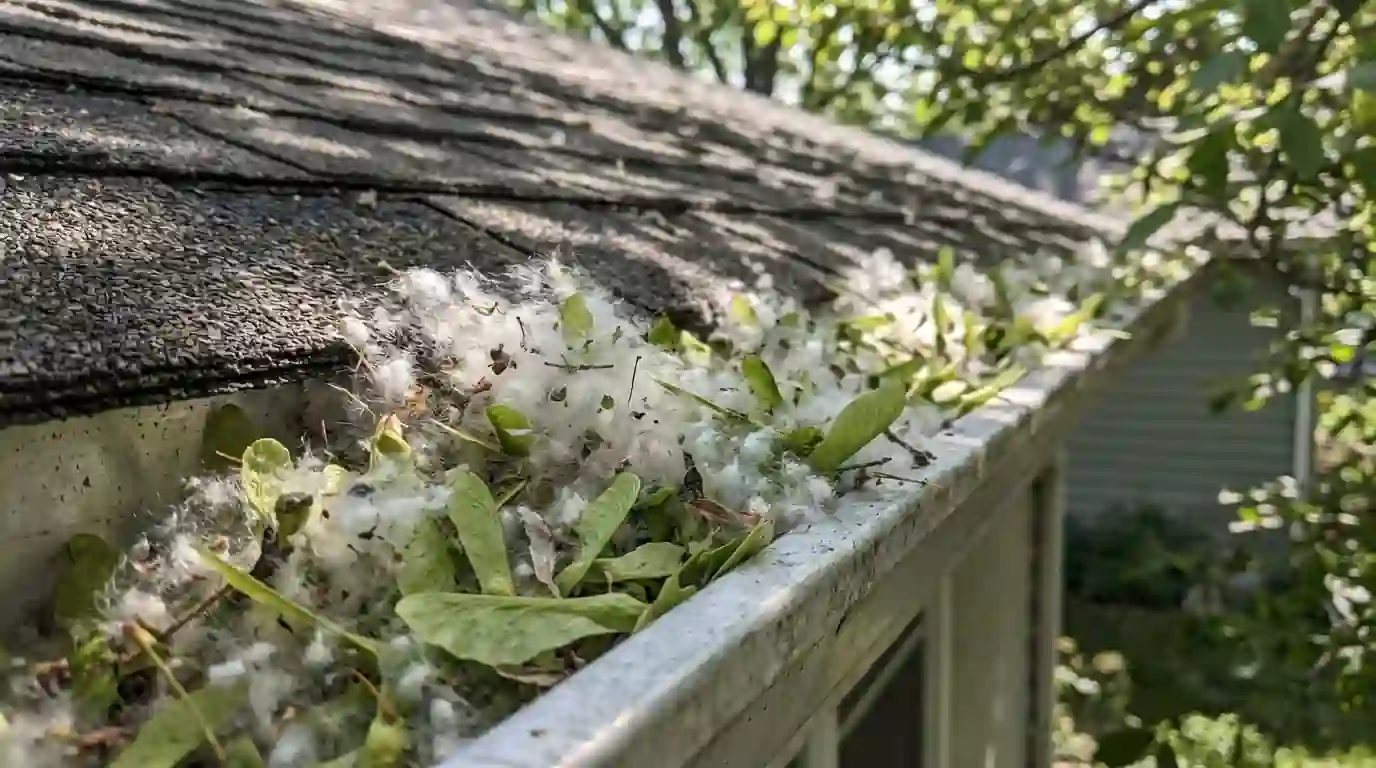
Nebraska made the eastern cottonwood its state tree in 1972, and it grows along creeks, river corridors and older yards all over the metro. In late spring it lets go of its seed in a cottony drift that can look like a snow squall. That fluff does not just sit in the gutter. It mats into a wet felt that seals outlets and packs downspout elbows.
Silver maple piles on. It was widely planted as a yard and street tree, it sets heavy seed crops in late spring, and the Nebraska Forest Service notes that its winged seeds commonly clog gutters. Left in wet debris, those seeds sprout, and by early summer you can see seedlings standing up out of the trough.
Timing matters because May is the wettest month in Omaha on average, with August and June close behind. A gutter sealed with fluff and seeds going into the heaviest rains of the year is how overflow, fascia rot and wet basement corners begin. Under either tree, clean right after the drop ends, not in April before it starts. Our cottonwood season guide goes deeper on that window.
Oaks, honeylocust and pines, the fall stretch
Oak leaves are big enough to bridge across the gutter and dam it. Some oaks also hang onto dead leaves well into winter and release them in waves, so a clean in early November can be undone a few weeks later. Under oaks, schedule the fall visit late, or plan for two.
Honeylocust is a common choice along sidewalks, in parking lot islands and in downtown districts because it tolerates poor soil and tight root space. Its leaflets are small enough to wash toward the outlet, where they collect into a dense plug. Trees that set seed also drop long, twisted pods that lodge crosswise in the trough.
Pine and spruce shed needles all year with a heavier fall drop. Needles slide past screens and stack up in downspout elbows. Under conifers, the gutter can look clear from the ground while the downspout below it is packed solid, so outlets need checking at every visit.
Signs your schedule is too long
Any calendar is a guess. The house tells you when the guess is wrong, and any of these signs means the gutters are due now, no matter when they were last cleaned.
- Water spilling over the front edge in an ordinary rain.
- A downspout that trickles or stays dry while rain is steady.
- Seedlings or grass growing out of the gutter.
- Runs pulling away from the fascia under the weight of wet debris.
- Dark streaks or peeling paint on the fascia board behind the gutter.
- Mosquitoes hovering around the eaves in summer, a sign of standing water.
Other things that change the count
Trees are the biggest factor, but not the only one. A new roof sheds loose granules for its first year or two, and that grit settles like sand in the low spots of the gutter. Steep roofs feed debris into the trough faster than low-slope ones, and long runs with a single downspout clog sooner than short runs drained at each end.
Corner lots and open ground catch wind-blown leaves from the neighbors, often piling into the same side of the house every fall. An undersized gutter overflows with less debris in it than a correctly sized one. And if the same run overflows right after a clean, the cause may be pitch or a packed downspout elbow rather than leaves.
What guards do to the schedule
Guards reduce cleanings. They do not end them. Fine micro-mesh guards stop cottonwood fluff and maple seeds far better than screens, but fluff and pollen can still mat on the top surface and need brushing or rinsing. Under heavy cottonwood, a guarded gutter may drop from three cleanings a year to a yearly top rinse and an outlet check.
Whether that trade pays off depends on your trees, your roof height and how you feel about ladders. Our guide on whether guards pay off lays out the tradeoffs by tree type.
Doing it yourself or calling a crew
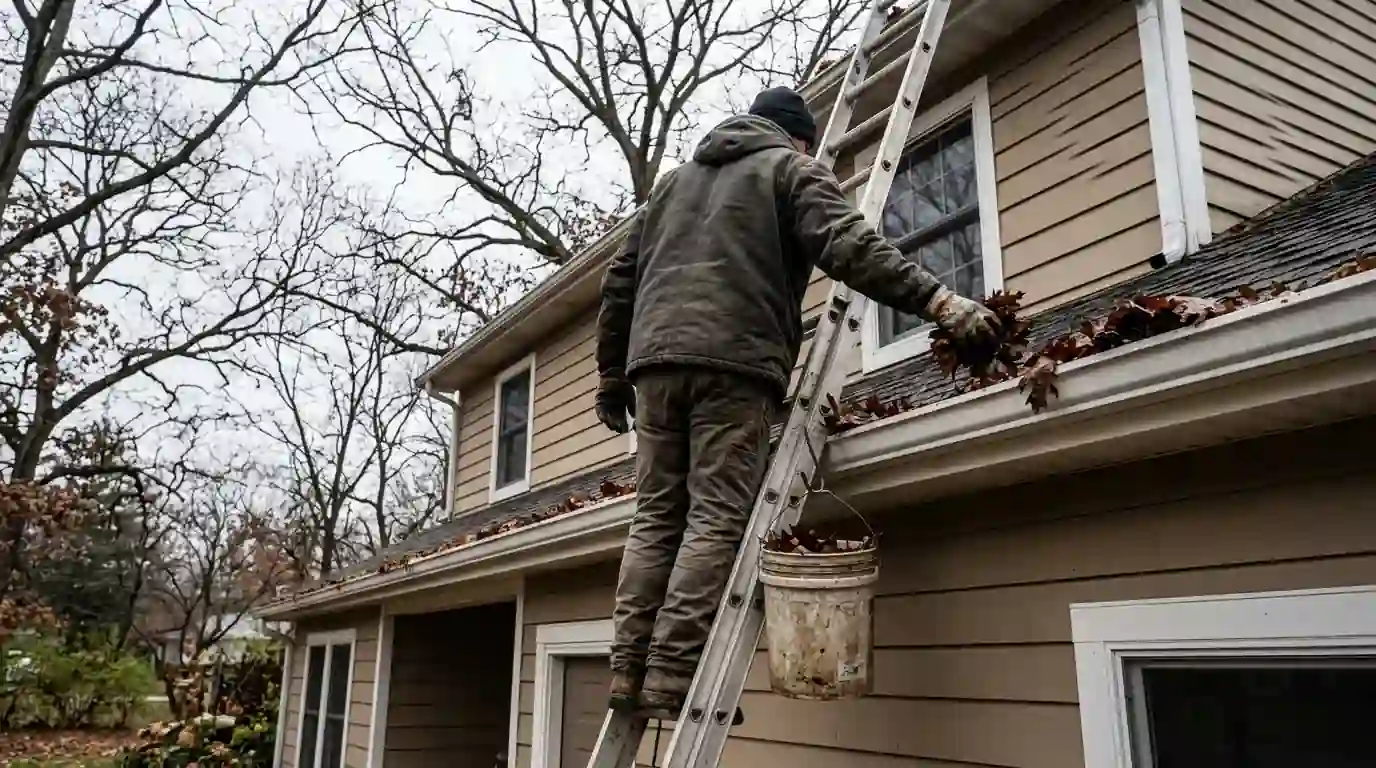
A single-story ranch with flat, firm ground around it is a reasonable weekend job for a careful homeowner with a stable ladder and a helper. Scoop by hand, bag the debris, and run a hose down each downspout until it flows clear. Two-story eaves, steep pitches, walkout backs and slick spring roofs are where ladder falls happen, and where the job is worth handing off.
A professional gutter cleaning should include hand removal, bagging, a downspout flush and a look at hangers, seams and pitch while the gutter is empty. If you would rather not track the dates yourself, a maintenance plan puts visits on the calendar around your trees. Our cleaning schedule tool suggests timing for your yard, or you can call us to set it up.
Agatha Prewitt, Gutter Guides Editor
Writes the gutter guides for Hastings Seamless Gutters, drawing on what our crews see on Omaha roofs through hail season, cottonwood season and winter.
FAQ
Questions readers ask
Is cleaning gutters once a year ever enough around Omaha?
For a house with no trees close enough to drop on the roof, often yes, especially when the gutters are sized right and the downspouts flow well. Take a quick look each spring and after big storms anyway, because wind still carries debris and new roofs shed grit. Once a cottonwood, maple or oak hangs over the roof, a single yearly clean is not enough.
When is the best time to clean gutters under cottonwood trees?
Right after the seed fluff stops falling in late spring, ahead of the heavy June storms. Cleaning in April feels proactive but leaves the gutter open for all the fluff that follows. If the drop runs long, a second quick pass may be needed. Flush the downspouts too, because matted fluff packs into elbows and stays there.
Can thin pine needles really clog a gutter?
Yes, just more slowly and in different places. Needles slide along the trough and gather at outlets and elbows, where they knit into a plug that holds back water and grit. Because the open gutter can look fairly clean from the ground, the clog often goes unnoticed until the downspout stops flowing. Checking and flushing the outlets is the key step under pines.
Should gutters be cleaned before a Nebraska winter?
Yes, after the last leaves fall and before steady freezing sets in. Wet debris left in a gutter freezes into a solid mass, blocks meltwater on warm days and adds weight that strains the hangers. A clean, flowing gutter going into winter gives snowmelt somewhere to go during the thaws between cold snaps.
Questions about your own gutters?
Call and describe what you are seeing. The line is answered 24/7 and a crew can come out to measure.