Seamless gutter installation
Seamless Gutter Installation in Omaha, NE
Sectional gutters leak at every joint, and in an Omaha downpour those joints are where water ends up on your siding, your window wells and your basement walls.
- Phone answered 24/7
- Our own crews
- Measured and priced on site
 Omaha, Nebraska
Quick answer
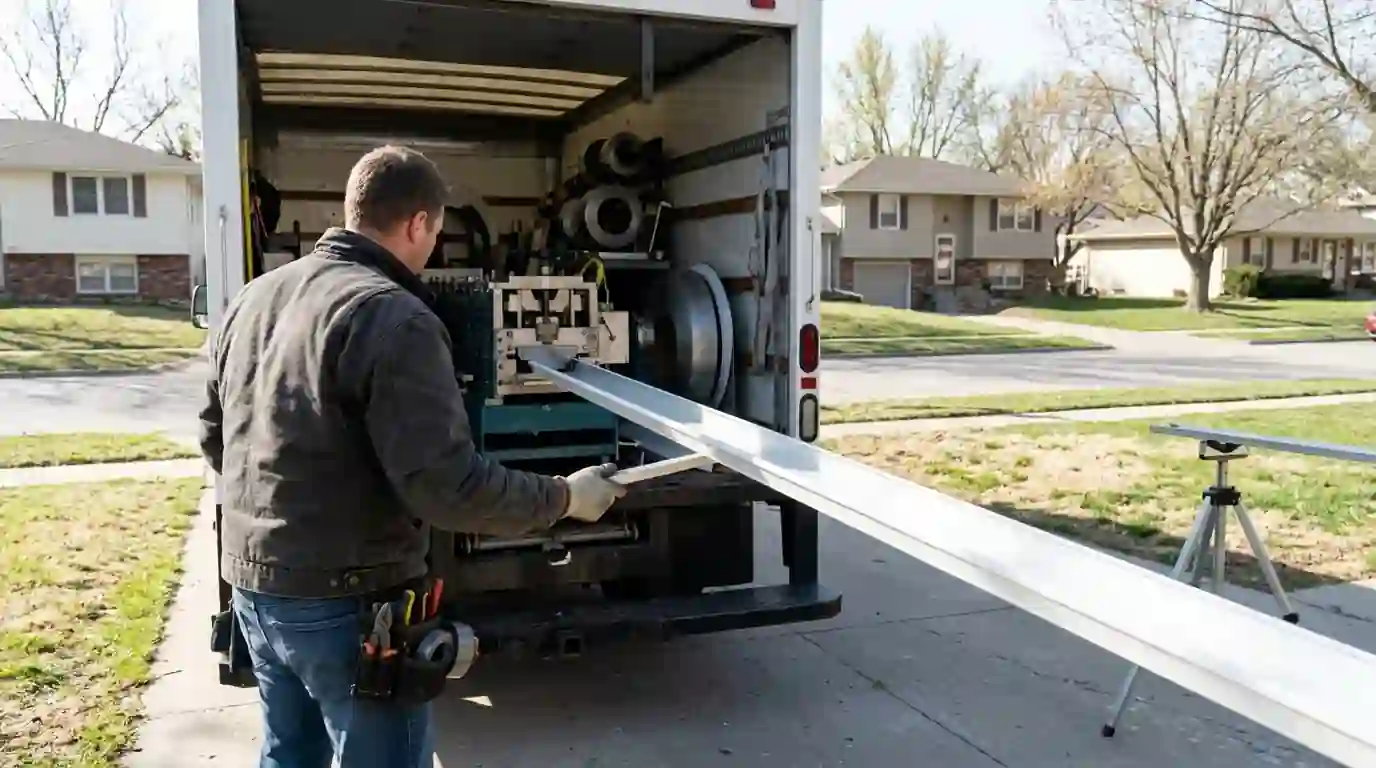
Seamless gutter installation means we roll each gutter run from a coil of painted aluminum on our truck, cut it to the exact length of that roof edge, and hang it in one piece. The only joints left are the corners and the downspout outlets, which is why seamless systems leak far less than store-bought sections.
A typical Omaha house has somewhere between four and ten gutter runs. With sectional gutter, each of those runs is pieced together from ten-foot lengths snapped or riveted end to end, and each splice depends on a bead of sealant. Sealant dries, shrinks and cracks after a few hard winters, and then the dripping starts.
Our crews bring the roll former to your driveway, measure every eave, and form each run on the spot. You end up with one continuous trough from end cap to end cap, sized and colored for your house, hung on hidden hangers screwed into solid wood. If an old system has to come off first, our gutter replacement page explains how the tear-off works.
How a roll former makes a seamless run
The machine on our truck takes a flat coil of pre-painted aluminum and pushes it through a series of rollers that bend it into the gutter profile, usually 5-inch K-style. A run comes out the back of the machine as long as we need it, whether that is a twelve-foot porch or a forty-five-foot rear eave.
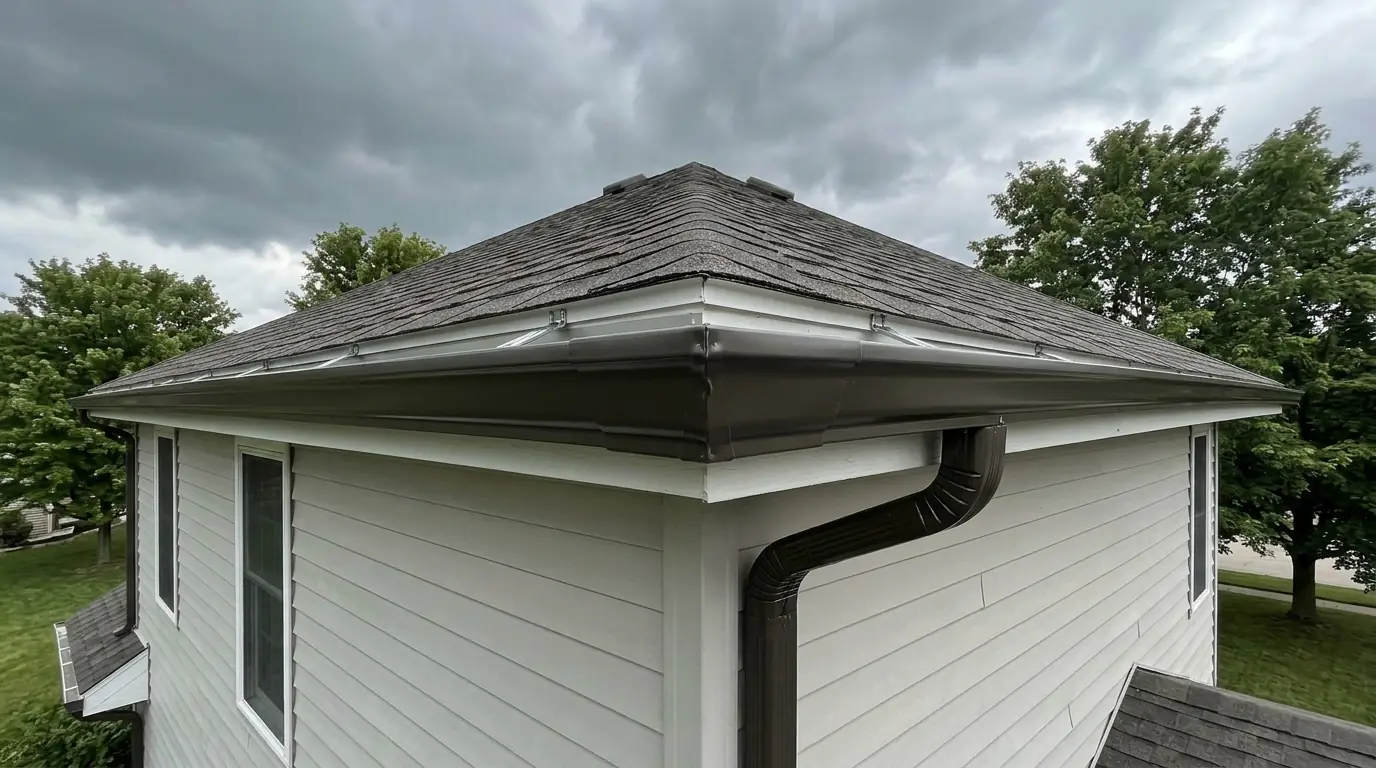
Because the gutter is formed to length, there is no lap joint in the middle of the run. Corners are mitered and sealed, end caps are crimped and sealed, and downspout outlets are cut and riveted in place. That short list covers every place a seamless system can leak, and we build each one on site.
Coil gauge, hangers and the parts you do not see
Residential aluminum coil comes in a few thicknesses. The thinner .027 coil is common and cheaper, but we lean toward .032 on long runs, on houses under big trees and anywhere hail and ladders take a toll, because the heavier metal holds its shape and resists rippling between hangers.
Hangers matter as much as the metal. We use hidden hangers that clip inside the front lip and screw through the back of the gutter into the fascia and, where we can find them, the rafter tails. Typical spacing is about every 24 inches, tighter below valleys and under roof planes that shed snow.
Pitch and outlet placement
A gutter that looks dead level is a gutter that holds water. We snap a line along the fascia and set the run to fall toward each outlet, roughly a quarter inch for every ten feet as a working guide. On runs over about 40 feet we usually pitch from the middle to an outlet at each end rather than asking one downspout to carry the whole eave.
Outlet location is decided by the roof, not by convenience. A valley that dumps into the middle of a run needs an outlet close by, and a downspout that lands on a driveway or next to a window well is a problem we would rather solve at the layout stage. Our downspout installation page covers how we pick spots.
Colors and matching the house
Coil comes in a long list of factory-baked colors, from white and almond through several browns, grays, clay, black and dark bronze. Most homeowners match the gutter to the trim or fascia so it disappears, and some match the downspouts to the siding so they fade into the wall. Our guide to gutter color walks through the choice. The finish is baked on at the coil mill, so there is no painting on site.
Why seamless outlasts sectional
Sectional systems from the home center are fine for a small shed. On a house, every splice is one more place for water to sit, for ice to pry and for sealant to give up.
Seamless runs also hold their line better. With fewer pieces there is less flex along the length, so the pitch we set on install day is the pitch you still have years later, provided the hangers stay tight in sound wood.
What to look for
Signs your house is ready for seamless gutters
Drips at every joint
Water falls from the splices of a sectional run during rain, leaving stripes on the siding and wet spots on the patio or walk below the eave.
Bare eaves
Plenty of homes only have gutters across the front. Eaves without gutters dump roof water right at the foundation, into window wells and onto flower beds.
Sealant patches everywhere
When a gutter carries more caulk than bare metal along its seams, the patches are telling you the joints have failed and will keep failing each season.
Overflow in summer storms
Water sheets over the front edge in heavy rain because the system is undersized, poorly pitched or short on outlets for the roof area feeding it.
Rusted steel gutters
Old galvanized gutters on many Omaha homes rust from the inside out, especially at seams and outlets where water and debris sit after every rain.
A new roof coming
A roof replacement is the cleanest time to put up new gutters, since the drip edge and fascia are exposed and can be checked before anything is hung.
How the job goes
What install day looks like
- 1
Measure and walk the roof line
We measure every eave, note valleys, roof planes and where water lands now, and mark outlet positions with you so downspouts end up where water can drain away from the house.
- 2
Check the fascia
Before anything is hung we probe the fascia for soft spots. Rotted boards get cut out and replaced so the new hangers have solid wood to bite into.
- 3
Roll the runs on site
Each run is formed from coil on the truck, cut to length, and fitted with end caps, mitered corners and outlets on the ground before it goes up the ladder.
- 4
Hang, pitch and seal
Runs are lifted into place, set to a string line for fall, and fastened with hidden hangers into the fascia. Corners and caps are sealed with gutter sealant made for aluminum.
- 5
Downspouts and cleanup
Downspouts, elbows and straps go on, extensions are set to carry water out, and we water-test each run before picking up every scrap of trim coil and cut metal.
Pricing
What seamless gutters cost
Seamless aluminum is priced by the linear foot of gutter, with downspouts, corners and any fascia work added on top. The table below shows published ranges so you can see where your house is likely to land.
| Item | Published range |
|---|---|
| Seamless installed, Omaha estimate | $7.67 to $18 per foot |
| Seamless aluminum installed, national | $14 to $20 per foot |
| Seamless aluminum coil, material only | $4 to $9 per foot |
| Installation labor only | $4 to $10 per foot |
| Whole-house install, typical total | $2,200 to $5,000 |
National ranges published by Handoff, Fixr, Angi, HomeGuide. Your price depends on the house; we give you a number on the phone or at the house before any work starts. See the full gutter price guide.
Roof height, the number of corners, .032 versus .027 coil and any fascia repair move the price most. Our price guide explains each line.
Omaha conditions
Built for Omaha rain, hail and ice
Omaha gets about 31.7 inches of rain and melted snow in an average year, and a big share of it falls in late spring and summer, with May the wettest month at around 4.7 inches. Those totals tend to arrive in short, heavy bursts, so a gutter system has to move a lot of water quickly instead of trickling it off over a day.
Nebraska also ranked first in the country for hail risk in a recent analysis of federal data, and our winters now swing above and below freezing more often than they used to. That combination is why we push for heavier coil, closer hanger spacing and outlets that drain meltwater before it refreezes in the trough. If ice is already a worry, ask about heated gutter cables.
Talk to a gutter crew about seamless gutter installation
Tell us what you are seeing at the roof edge. We answer around the clock and give you straight answers on repair or replacement.
FAQ
Seamless Gutter Installation questions
How long does a seamless gutter install take on an average Omaha house?
Most single-family homes are measured, formed and hung in one working day. A ranch with simple eaves often wraps up by early afternoon. Larger two-story homes, houses with many corners, or jobs that need rotted fascia replaced first can run into a second day. We do not hang gutters in lightning or on icy roofs.
Is .032 aluminum worth paying for over .027?
On short runs under light tree cover, .027 coil performs fine. We recommend .032 for long eaves, for homes where ladders lean on the gutter during cleaning, and for houses that take hail, because the thicker metal resists denting and holds a straight line between hangers. The price difference per foot is small next to the total job, and it is one of the cheapest ways to add life to the system.
Can a seamless gutter really be made in one piece for a very long eave?
Yes. The roll former can produce a continuous run of almost any length the truck can be parked to reach. Practical limits come from handling, since very long runs need several people to lift them without kinking. On eaves over about 40 feet we often split the pitch to outlets at both ends, but the gutter itself is still one piece with no splice in the middle.
Do seamless gutters still need sealant anywhere?
Yes, at the corners, the end caps and around the outlets. Those joints are built on site with rivets and a sealant made for aluminum gutters. What seamless removes is the splice every ten feet along a run, which is where sectional gutters most often fail. With far fewer sealed joints, there are fewer spots to inspect during cleaning and fewer places for winter ice to pry metal apart.
Should I add gutter guards at the same time as new seamless gutters?
It can make sense, especially under cottonwoods, silver maples or pines, because guards fit most cleanly on new gutters with fresh hangers. Not every house needs them, and guards still need an occasional rinse. Our gutter guard installation page explains which types suit which trees, so you can make the call while the new system is being planned.
Related gutter services
Checking costs? The gutter price guide lists published ranges, the gutter size calculator estimates 5 or 6 inch and downspout count, and the cleaning schedule planner shows how often your trees fill the gutters.