Specialty gutter work
Half-Round Gutters in Omaha for Older and Period Homes
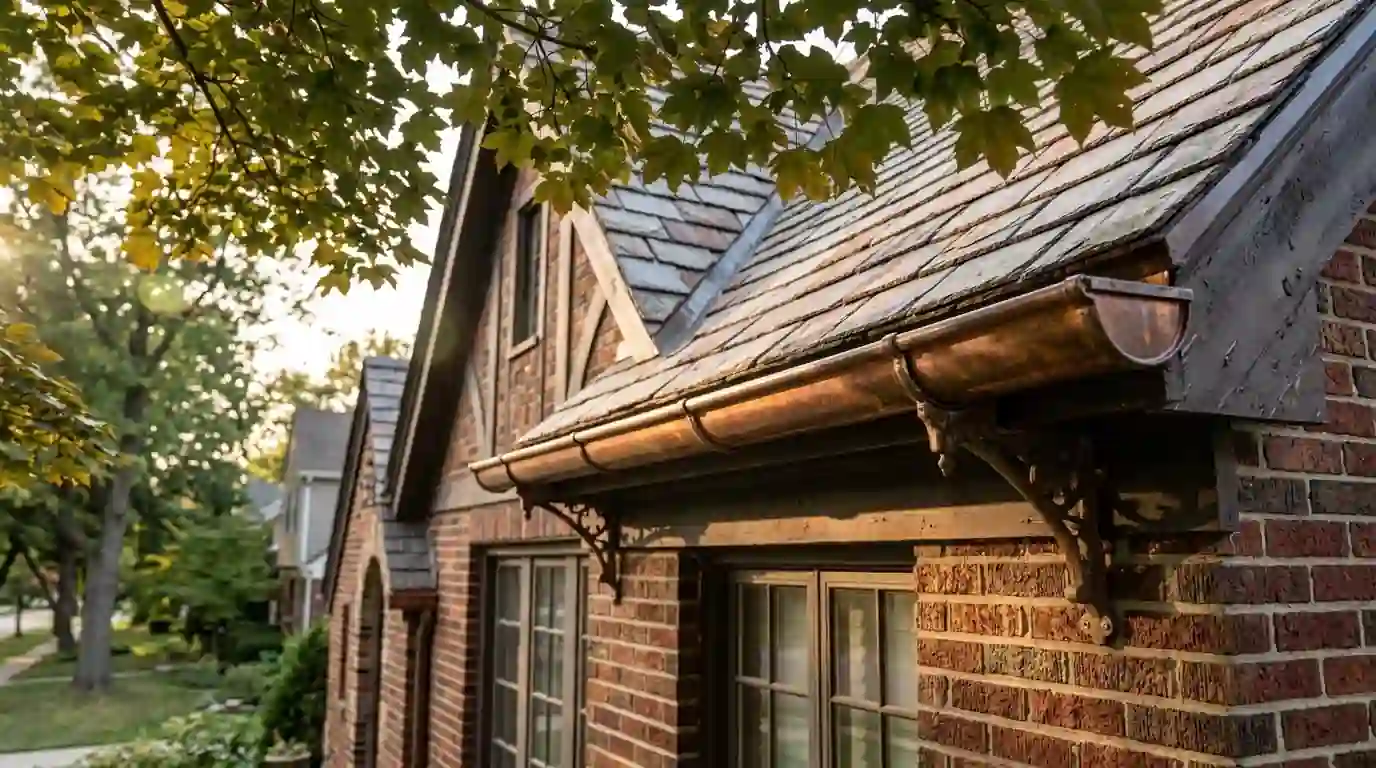
A boxy K-style gutter can look wrong on a 1920s Tudor or a Craftsman bungalow, and anyone who walks past can feel it. Half-round gutters bring back the profile those roofs were built to wear.
- Phone answered 24/7
- Our own crews
- Measured and priced on site
 Omaha, Nebraska
Quick answer
Half-round gutters are open, semicircular troughs hung from brackets and drained by round downspouts. We form them in aluminum, copper or steel for older Omaha homes where period looks matter, and for any roof where you want a softer line at the eave. They carry water a little differently than K-style, so sizing and bracket spacing get extra attention.
Walk through Dundee, Field Club or the blocks around St. Cecilia Cathedral and you will see plenty of houses wearing K-style gutters that were added in some later decade. The flat ogee face fights with stucco and half-timbering. Half-round is the shape most of these houses carried before aluminum coil took over the trade.
Omaha has a lot of that older stock. Close to a fifth of the homes in the city went up in 1939 or earlier, and many sit in districts where a rounded gutter reads as original. We hang half-round on those homes, on newer houses designed in a traditional style, and on porches or garages where the trim line should match the main roof. If you are still weighing profiles, our K-style gutter page lays out the other option.
How the half-round profile handles water
A half-round trough is a true semicircle with a rolled bead along the front edge. Because the bottom is curved, water gathers into a narrow channel and moves quickly once the run has pitch.
The tradeoff is depth. A 5-inch half-round holds less than a 5-inch K-style, because the K profile has a flat back and a deeper cross section. On a long, steep slope we usually step up to a 6-inch half-round or add a second outlet so the run does not spill over the bead in a hard storm.
Aluminum, copper or steel
Aluminum half-round is the most common choice. It is light, it will not rust, and it comes in painted finishes that can match trim on a stucco Tudor or a painted Craftsman. It also dents more easily than the other two metals, which matters in a city that sees as much hail as Omaha does.
Copper is the traditional material for this profile. It is soldered at the seams rather than sealed, and it weathers from bright penny to brown and eventually to a green patina. Our copper gutter work covers that metal in more depth, including why copper must never touch aluminum or galvanized fasteners.
Steel half-round, usually Galvalume, sits between the two: tougher against hail than aluminum, cheaper than copper.
Brackets and the details people notice
Half-round does not use the hidden screw hangers that hold up a K-style gutter. It sits in brackets, and the bracket style is a big part of the look. Fascia brackets screw to the face of the board. Strap or shank brackets fasten under the roof edge and wrap around the outside of the trough, which works on houses with exposed rafter tails or a sloped fascia.
We space brackets close, typically every 24 to 30 inches, and tighter where snow piles up on north-facing eaves. Decorative cast brackets can go on the front elevation, with plain ones on the back to keep the cost in check.
Round downspouts and where they land
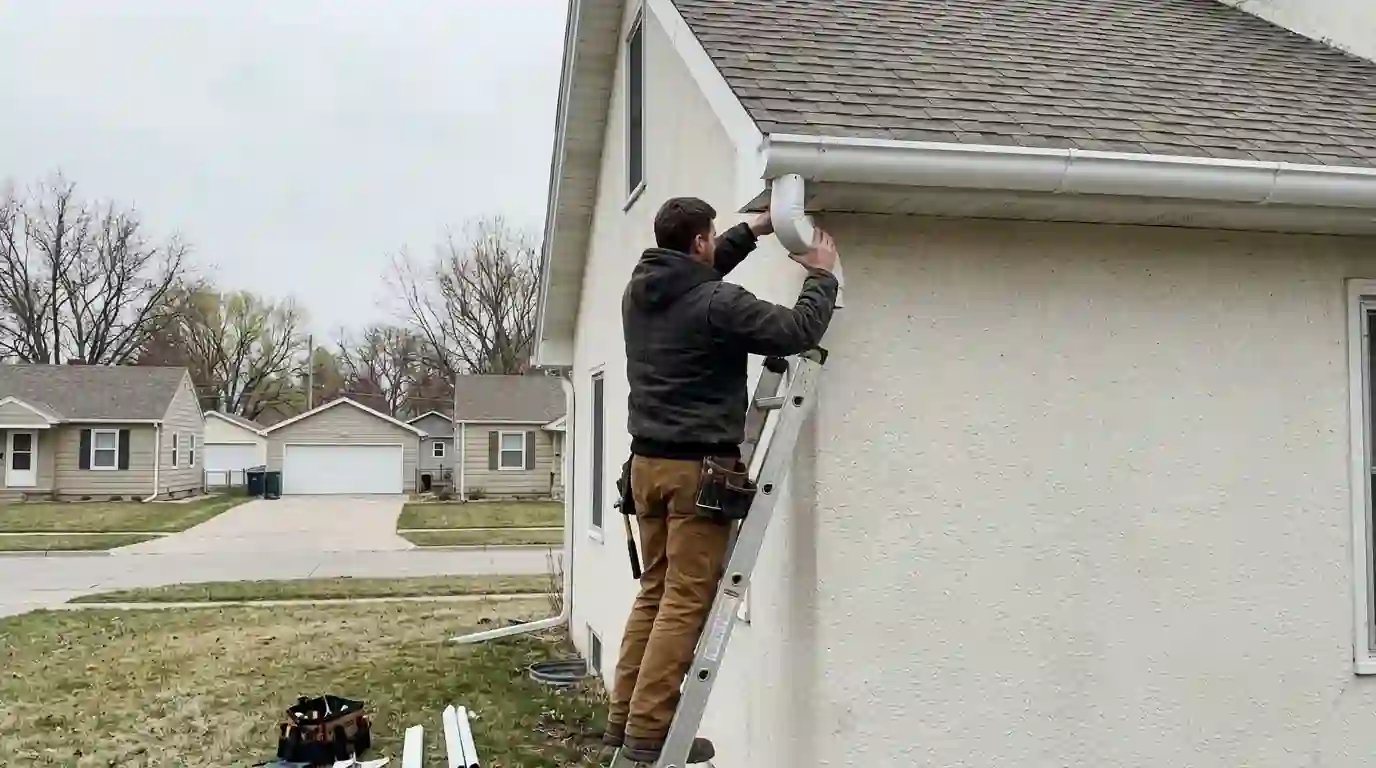
A round downspout looks right below a half-round gutter. It connects at a drop outlet soldered or sealed into the trough. Round pipe packs with seeds at the elbow a bit more readily, so we keep elbows to a minimum.
At the ground, the water still has to get away from the house. Homes from the prewar era often have stone or block foundation walls that do not tolerate water pooling at the corners. We pair new downspouts with downspout extensions or a buried line so the discharge lands well clear of the foundation.
Homes where half-round makes the most sense
The profile belongs on Tudor Revival, Colonial and Georgian houses, on Craftsman bungalows with exposed rafter tails, and on Victorian and Queen Anne homes with deep cornices. Many houses in the Country Club neighborhood are Tudor style, and the Dundee building boom after 1905 left streets of Colonial, Georgian and Tudor Revival homes. A good number of those houses lost their original gutters long ago.
If your house has gutters hidden inside the cornice instead, that is a different job, covered on our box gutter repair page.
What to look for
Signs your house is asking for half-round
Rounded trim and rafter tails
Exposed curved rafter ends, arched porch openings or rounded window heads read better with a curved gutter than with the flat face of a K-style.
Old bracket holes in fascia
Rows of filled screw holes or ghost marks along the fascia often show where original half-round brackets once hung before a later gutter replaced them.
K-style that looks added on
If the gutter seems like the one thing on the house that does not belong to its era, the profile is usually the reason, not the color.
Copper accents elsewhere
Copper flashing, a copper bay roof or a copper chimney cap suggests the house was designed with copper half-round at the eaves as well.
A restoration underway
Owners restoring an older home often aim to match original details, and the gutter profile is one of the most visible of them from the street.
Wet leaves rotting in corners
Flat-bottomed gutters under heavy trees can hold soggy debris in their corners, while the curved bottom of half-round tends to flush clean with each rain.
How the job goes
How we install half-round gutters
- 1
Measure and size the runs
We measure every eave, look at roof pitch and the size of each roof plane, then choose between 5-inch and 6-inch troughs and decide where outlets and downspouts will land.
- 2
Check the fascia and roof edge
Before any bracket goes up we probe the fascia and rafter tails for soft wood, and we look at the drip edge so water lands in the trough instead of behind it.
- 3
Set brackets to a string line
Brackets go up on a snapped line with steady fall toward each outlet, spaced close enough to carry wet leaves and a load of snow without the trough rolling forward.
- 4
Hang troughs and join fittings
Troughs drop into the brackets and are joined at miters, end caps and outlets. Copper is soldered, while aluminum and steel are riveted and sealed with gutter sealant.
- 5
Run round downspouts and test
Round elbows and straps set each downspout tight to the wall, then we run a hose through every section to watch for drips and confirm the discharge clears the foundation.
Pricing
What half-round gutters cost
Half-round runs a little more than K-style in the same metal, and material choice moves the price far more than profile does. The ranges below come from published national sources.
| Item | Published range |
|---|---|
| Half-round gutters, range across materials | $4 to $36 per foot |
| Added cost of half-round over K-style | $1 to $2 per foot |
| Half-round copper gutters | $19 to $40 per foot |
| Downspout installed, each | $30 to $75 per downspout |
National ranges published by Forbes Home, HomeGuide, Angi. Your price depends on the house; we give you a number on the phone or at the house before any work starts. See the full gutter price guide.
Metal is the biggest lever, followed by decorative brackets, the number of corners and downspouts, and whether old gutters come down first. Our price guide explains the rest.
Omaha conditions
Half-round on Omaha's older streets
Omaha's prewar neighborhoods were built before aluminum coil existed, and many of their roofs are steep, cut up with dormers and shaded by big trees. The curved trough suits that mix: it sheds maple seeds and leaves readily, and it looks right against brick, stucco and wood shingle. Dundee's developers planted about 2,000 maples along their streets, a reminder of how shaded these older blocks were meant to be.
Our wettest stretch runs from May through August, and May alone averages a little over four and a half inches of rain. On a steep Tudor roof that water arrives fast, which is why we size half-round generously and give each long run its own outlet. Ask about guards that fit half-round if the canopy overhead is heavy.
Talk to a gutter crew about half-round gutters
Tell us what you are seeing at the roof edge. We answer around the clock and give you straight answers on repair or replacement.
FAQ
Half-Round Gutters questions
Can half-round gutters handle as much water as K-style?
Size for size, no. A 5-inch half-round carries less than a 5-inch K-style because its cross section is shallower. The fix is simple: we choose a 6-inch half-round for large or steep roof planes and add outlets on long runs. Sized that way, half-round drains a typical Omaha roof through a normal summer downpour, and its curved bottom flushes debris toward the outlet well.
Can half-round gutters go on a house with no fascia board?
Yes. Many older homes have exposed rafter tails or a sloped fascia, and half-round is often the better fit there. We use strap or shank brackets that fasten to the roof deck under the first course of shingles or to the rafter tails themselves. On a worn roof we may suggest timing the work with roof repairs.
Do gutter guards fit a half-round trough?
Some do, many do not. Plenty of guards are made for the flat back and front lip of a K-style gutter and will not seat in a curved trough. There are guards built for half-round profiles, including mesh styles that clip into the front bead. We look at the trees above your roof and the gutter size before recommending one, because the guard has to suit both the debris and the shape.
Should half-round be aluminum or copper on a historic home?
It depends on how close to original you want to get and on budget. Copper is the traditional material and ages to a patina that suits brick and stone. Aluminum half-round in a painted finish gives the same shape for far less money and is easy to color match to trim. Steel falls between them. On many Omaha period homes, aluminum half-round alone is a big improvement over K-style.
Can you mix half-round in front with K-style in back?
We can, and some homeowners do it to save money on elevations nobody sees from the street. The two profiles need a transition piece where they meet at a corner, or a separate downspout at the change. We usually recommend keeping one profile on any continuous roof edge so the joint does not become a leak point. Rear additions and detached garages are natural places to switch.
Related gutter services
Checking costs? The gutter price guide lists published ranges, the gutter size calculator estimates 5 or 6 inch and downspout count, and the cleaning schedule planner shows how often your trees fill the gutters.