Gutter guards
Micro-Mesh Gutter Guards in Omaha, NE
If your gutters fill with white fluff every late spring, or helicopter seeds plug the downspouts each May, ordinary screens are not going to keep up.
- Phone answered 24/7
- Our own crews
- Measured and priced on site
 Omaha, Nebraska
Quick answer
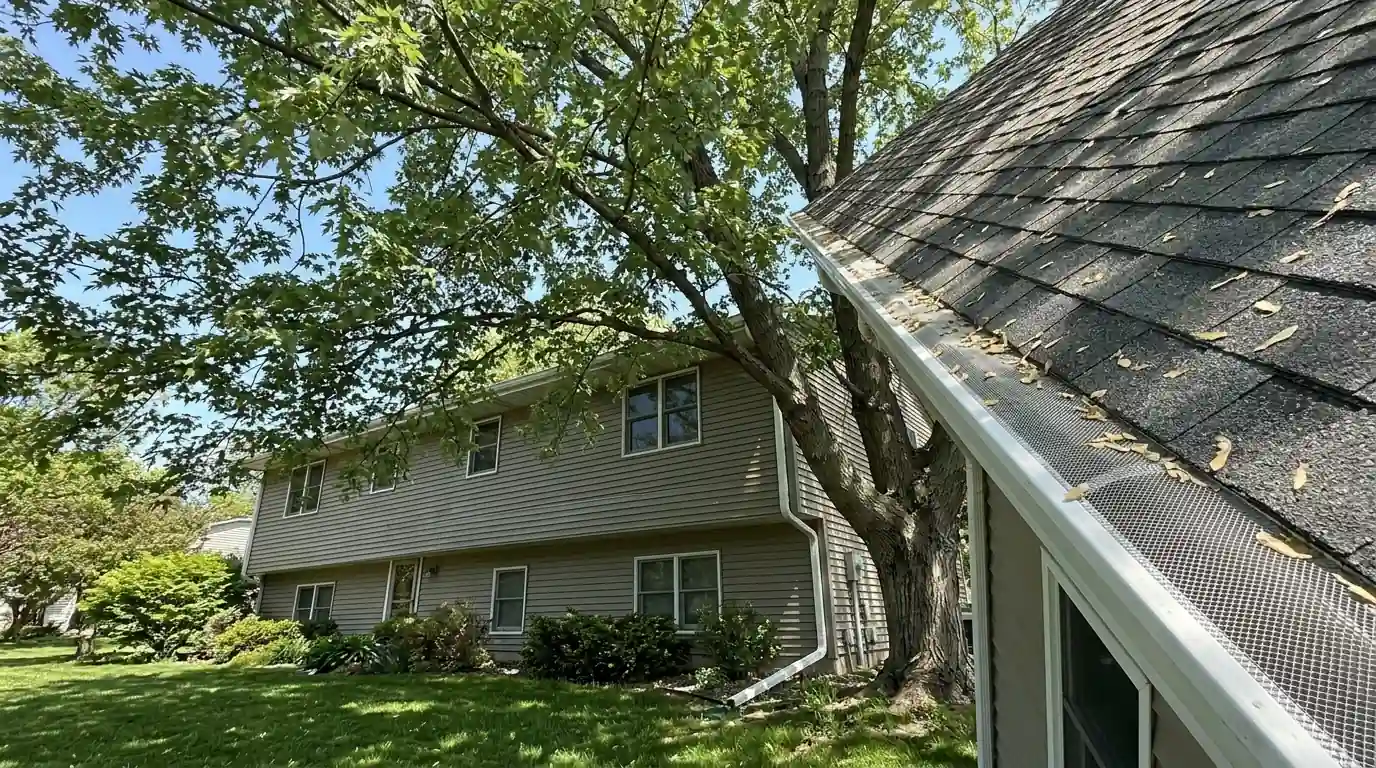
Micro-mesh gutter guards are covers made of fine stainless steel mesh stretched over a rigid aluminum frame. The openings are small enough to stop cottony seed fluff, winged seeds, pine needles and shingle grit, while water passes through by surface tension. They suit homes under cottonwoods, maples and conifers where other guards clog.
The idea is simple. Water clings to the fine wire and drops through the mesh into the gutter, while almost everything solid stays on top. Leaves dry out and blow off. Fluff and seeds sit on the surface until wind or rain moves them along.
The quality of the frame matters as much as the mesh. A flimsy frame sags between fasteners and lets the mesh dip, and dips collect debris. We use guards with a stiff aluminum body that holds a flat or slightly forward-tilted surface across the whole gutter, so debris has nowhere to settle.
Stainless mesh versus aluminum or plastic
Stainless steel is the material that makes micro-mesh worth the price. It does not rust, it holds its weave under foot traffic from wind-blown branches, and it shrugs off year after year of freeze and thaw. Aluminum mesh is cheaper but softer, and it dents when a branch lands on it. Plastic mesh turns brittle after a few winters of sun and cold.
The weave should be tight enough that cottonwood fluff stays on top, yet open enough for heavy summer rain to pass. A good mesh handles a hard storm without water sheeting over it, which is the main complaint about cheap fine screens.
Installation choices: under the shingle or on the lip
Some micro-mesh guards slide a back flange under the first shingle course and rest on the front lip of the gutter. The shingle overlap means nothing slips in behind the guard. It works well on a roof in good shape where the shingles lift without cracking.
Others fasten to the front lip and tuck against the fascia or the drip edge at the back, with no shingle contact at all. This is our default on older roofs, brittle shingles, or where a homeowner wants to keep the roof untouched for warranty reasons. If the roof edge lacks a drip edge, we often add one first, which our drip edge installers handle as part of the job.
Either way, we keep a slight forward tilt so water and debris move off the front rather than pooling.
What micro-mesh handles best
This guard is built for the smallest debris that defeats other covers.
- Cottonwood fluff, which felts into a mat inside open gutters
- Silver maple and elm seeds that wedge into screens
- Pine and spruce needles that spear through perforations
- Shingle granules that wash off asphalt roofs and settle like sand
- Pollen clusters and small twigs during spring storms
Winter behavior and upkeep
In freezing weather, a thin film of ice can form over the mesh on cold nights. As the sun warms the roof, meltwater usually works through the openings again by midday. A heavy snow sits on top of the guard instead of filling the trough, which keeps the gutter from turning into a solid block of ice.
The top surface needs a light brushing or a rinse now and then, mostly after cottonwood season and in fall. Fine pollen and seed dust can build a skin that slows water. A soft brush on a pole, or a visit from our guard cleaning crew, clears it in a few minutes per run.
What to look for
Signs micro-mesh is the right guard
Fluff in the gutters
If you scoop white cottony mats out of the troughs every June, larger-hole guards will just let it through and hold it inside.
Seeds packing downspouts
Winged seeds that jam elbows each spring point to a guard fine enough to stop them before they reach the outlet.
Screens already clogging
Existing screens or foam inserts that fill up or grow seedlings show the debris is too small for them.
Sand in the trough
Gritty sediment at the bottom of the gutter is shingle granules, which settle and hold moisture against the metal over time.
Conifers near the roof
Pine and spruce drop needles all year, and they slip end-first through almost every guard except fine mesh.
Roof you rarely want to climb
Tall two-story walls and steep pitches make micro-mesh a sensible long-term choice, since it cuts down how often anyone goes up.
How the job goes
How we install micro-mesh
- 1
Inspect gutters and roof edge
We check pitch, hangers, seams and the shingle edge to decide on an under-shingle or lip-mount fit, and repair any loose or leaking sections first.
- 2
Clean out and flush
Every trough is hand-cleaned and every downspout flushed, since sealing old debris under new guards would defeat the point.
- 3
Fit frames to each run
Panels are cut to length, notched around hidden hangers and mitered at inside and outside corners so the mesh stays continuous and flat.
- 4
Fasten and tilt
Guards are screwed to the front lip at close spacing and set with a slight forward pitch, so debris slides off rather than resting on top.
- 5
Water test the valleys
We run a hose at valley corners and steep sections, where water arrives fastest, to confirm it drops through the mesh instead of overshooting.
Pricing
Micro-mesh guard pricing
Micro-mesh sits at the higher end of guard pricing because of the stainless mesh and rigid frame. The table shows a typical average and the wider range across guard types.
| Item | Published range |
|---|---|
| Micro-mesh guards, average paid | $40.50 per foot |
| Pro-installed guards, all types | $15 to $45 per foot |
| Drip edge added first, per foot | $1 to $3 per foot |
| Gutter cleaning before install | $100 to $250 |
National ranges published by This Old House, HomeGuide, Angi. Your price depends on the house; we give you a number on the phone or at the house before any work starts. See the full gutter price guide.
Second-story runs, steep roofs, lots of corners and any gutter repair or drip edge work done first raise the total. Simple one-story runs with few corners cost less per foot.
Omaha conditions
Built for cottonwood season
Nebraska chose the eastern cottonwood as its state tree in 1972, and anyone who lives near one knows its late spring seed drop. The fluff drifts across whole blocks and settles into every open gutter it finds. Within days it felts into a wet mat that blocks outlets and sends rain over the edge during May and June storms.
Silver maples, planted along many Nebraska streets, add a heavy seed crop at about the same time. Micro-mesh is the guard we recommend most often on homes under those two trees. Read our cottonwood season guide for timing, or see how mesh compares with other covers on our gutter guard page.
Talk to a gutter crew about micro-mesh gutter guards
Tell us what you are seeing at the roof edge. We answer around the clock and give you straight answers on repair or replacement.
FAQ
Micro-Mesh Gutter Guards questions
Does micro-mesh handle a heavy Omaha thunderstorm?
A good stainless mesh passes a lot of water, and in most summer storms the gutter fills from below before the mesh is overwhelmed. In the heaviest bursts, some water can sheet over the front if the mesh has a film of pollen on top. Keeping the surface clean and the guard tilted slightly forward lets it handle downpours.
Will fluff and seeds pile up on top of the mesh?
Some will land and sit for a while, especially on flat runs and at corners. On a dry, breezy day most of it blows off. After a heavy cottonwood drop, a quick brushing with a soft broom on a pole clears what is left. That takes minutes compared with scooping wet mats out of open gutters every few weeks.
Can micro-mesh go on 6-inch gutters?
Yes. Micro-mesh comes in widths for both 5-inch and 6-inch K-style gutters, and we use the matching size so the frame spans the full trough and fastens properly. Wider gutters under big roofs and valleys benefit most, since the mesh keeps debris out of a trough that carries a lot of water in a storm.
Does installing micro-mesh affect my shingle warranty?
Some roof warranties have terms about lifting or fastening into shingles, and the details vary by manufacturer. We cannot tell you what your warranty says, so we offer a lip-mounted style that never touches the shingles. If you know your roof terms allow an under-shingle fit, we can use that instead. Either way, the guard itself works the same.
How long do stainless micro-mesh guards last?
The stainless mesh itself resists rust and holds its shape for many years, and the aluminum frame does not corrode in normal conditions. What usually ends a guard's life is the gutter beneath it wearing out or a roof replacement. Guards can be removed and reset during a reroof, which we handle as part of a detach and reset.
Related gutter services
Checking costs? The gutter price guide lists published ranges, the gutter size calculator estimates 5 or 6 inch and downspout count, and the cleaning schedule planner shows how often your trees fill the gutters.