Gutter guide
Built-In Box Gutters on Older Omaha Homes
If your house went up before the Second World War and you cannot see a gutter hanging off the roof edge, it may have one hidden inside the cornice. Built-in box gutters last well until the lining fails, and then they leak into the house.
By Agatha Prewitt, Gutter Guides EditorUpdated
The short answer
A built-in box gutter is a wooden trough framed into the cornice and lined with metal, so the gutter sits inside the roof edge instead of hanging from it. When the liner cracks or rusts, water runs into the framing, the soffit and the walls. The fixes are a new soldered metal or membrane liner, wood repair underneath, or a conversion to hanging gutters.
Call (402) 395-0908How to tell if your house has one
Stand across the street and study the roof edge. A hanging gutter shows as a separate trough fastened to the fascia. A built-in gutter does not show at all, or appears only as a thick, molded cornice with the shingles stopping short of its outer edge. Downspouts that start from under the cornice rather than from a visible trough are another giveaway.
Omaha has plenty of houses old enough to have them. About 17.8 percent of homes in the city were built in 1939 or earlier. Dundee filled in with Colonial, Georgian and Tudor Revival houses after 1905, and the Gold Coast blocks of the Cathedral neighborhood hold Colonial Revival, Tudor Revival and Queen Anne homes built from the 1880s into the 1940s. Hanscom Park is one of the oldest residential subdivisions in the city, and Field Club listings include houses from 1910 and 1913.
You may hear these called Yankee gutters, built-ins or cornice gutters. Some are true boxes behind a decorative crown molding, and some are metal-lined channels set on the roof just above the eave. Both work the same way and fail the same way.
How they were built
A carpenter framed a trough into the rafter tails and sloped it toward the outlets. A tinsmith then lined it with sheet metal, usually terne-coated steel or tin, and sometimes copper on the better houses. The liner ran up under the roofing on the back side and over the outer lip on the front, and outlets dropped through the floor of the box into the downspout, sometimes by way of a conductor head.
Done right, the design is excellent. The gutter is large, it is hidden in the trim, and it cannot pull away from the house. The weakness is that every leak drains straight into the structure. A hanging gutter that leaks drips on the lawn. A built-in gutter that leaks drips into the cornice, the top of the wall and sometimes the plaster of an upstairs room.

How box gutters fail
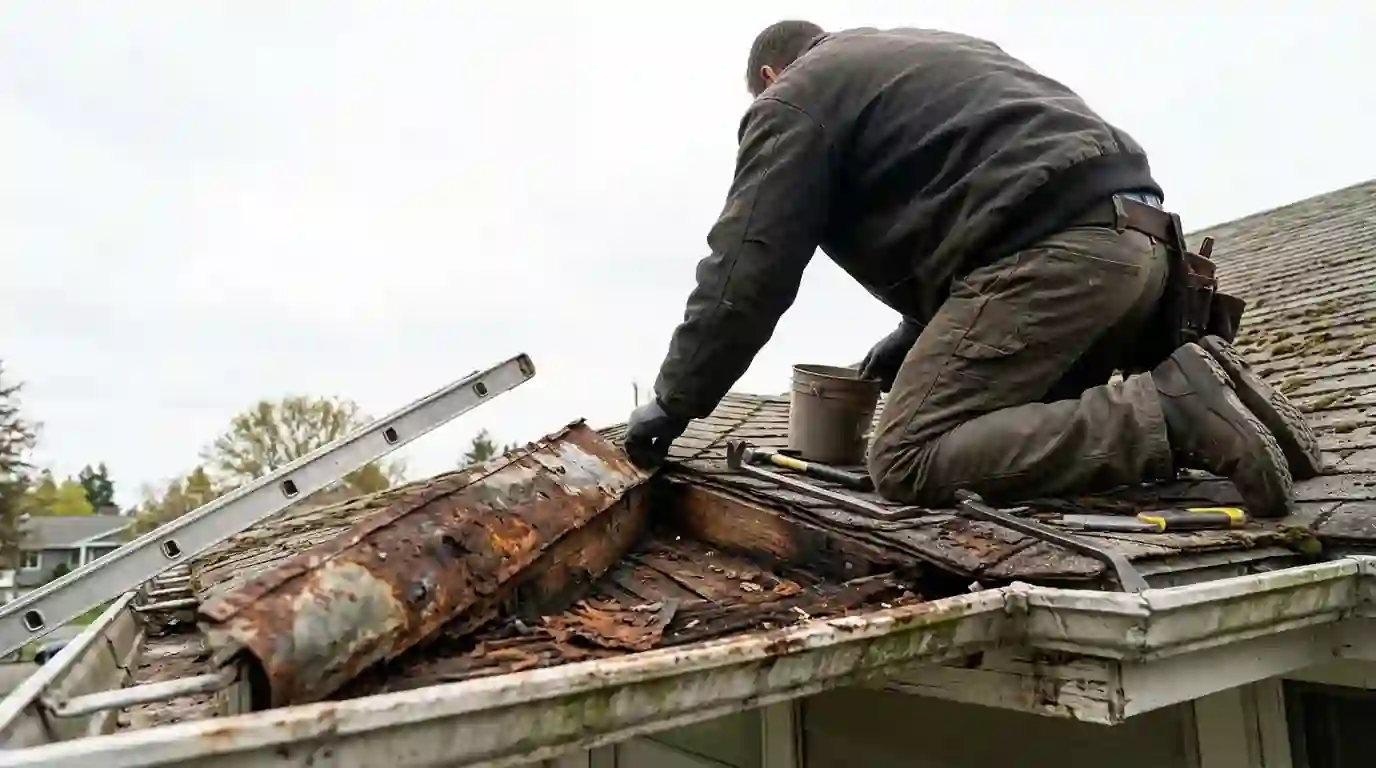
Old liners rarely give out all at once. They fail at seams, at outlets and in low spots where water stood for years. The usual sequence goes something like this.
- Paint on a terne or tin liner wears thin and rust pinholes open in the low spots.
- Soldered seams crack after years of expansion and contraction.
- Past repairs with roofing tar trap water and hide rot under the patch.
- Water reaches the wooden trough, which softens and sags and holds even more water.
- Ice packs the box in winter and lifts the liner or splits a seam.
- Stains show up on the soffit, the frieze board or a ceiling below the eave.
Why Omaha winters are hard on them
A built-in gutter sits at the eave, the coldest part of the roof, and it holds more snow and water than a hanging trough. January in Omaha averages a low of about 14.5 degrees, and the city averages about 27 inches of snow a year. Nebraska is also seeing fewer days below freezing and more multi-day winter thaws, which means more melt and refreeze cycles inside the box.
Each cycle lets meltwater pool, freeze and expand against the liner. Where an outlet is partly blocked, the box can fill with ice from end to end, and that pressure is what opens old seams. Our guide to ice dams and gutters covers the roof side of the same problem.
By the time a stain shows indoors, the wood under the liner has usually been wet for a while. Treat any soffit stain under a built-in gutter as a reason to open it up and look, not a reason to repaint.
Repair options and their tradeoffs
There are four realistic paths. Which one fits depends on how far the rot has gone, how much the look of the cornice matters to you and what you want to spend.
Whatever liner goes in, rotted wood beneath it has to come out first. A new liner laid over a soft trough sags, ponds water and fails early. Expect the final price to depend on what turns up once the old liner is pulled back. Our page on box gutter repair explains how a cornice gets opened and assessed.
| Option | What it involves | Tradeoff |
|---|---|---|
| Spot repair | Clean out, resolder or patch seams and outlets | Buys time on a mostly sound liner, not a lasting fix |
| Membrane reline | New single-ply membrane over sound or rebuilt wood | Lower cost than metal, edges and outlets need careful detailing |
| Metal reline | New soldered copper or coated steel liner | Longest life and most traditional, highest cost and labor |
| Convert to hanging | Roof over the box and hang new outside gutters | Ends the hidden leak risk but changes the cornice look |
Converting without losing the look
Some owners want the hidden leak risk gone for good. A conversion closes off the box, carries the roofing over it and hangs a gutter on the new edge. On a plain cornice a standard K-style can look fine. On a detailed Tudor or Colonial Revival front, a half-round gutter with round downspouts usually sits better against the period trim.
Where the cornice is the point of the house, a metal reline in copper keeps everything original and weathers to a patina that suits brick and stucco. It is the slowest and most expensive route, but it can outlast every other option on this list.
If your home sits in the Field Club or Country Club historic districts, both listed on the National Register, ask whether any local review applies before changing the roof edge. Relining leaves the exterior as it was. Converting does not.
Keeping a box gutter healthy
A sound built-in gutter needs more attention than a hanging one, because its problems hide. Clean it each spring and fall, keep the outlets fully open, and look along the liner for rust spots, cracked seams and old tar patches. Recoat terne and tin liners with a compatible coating before the paint wears through.
Check the soffit and frieze below the box every spring for fresh stains or peeling paint. Damaged soffit under a built-in gutter is almost always a symptom of the liner above rather than the main problem.
If you own an older home in Dundee, Field Club, Hanscom Park or the Cathedral area and you are seeing stains near the eave, call us. We can look at the liner, the wood and the outlets and lay out which repair path fits the house.
Agatha Prewitt, Gutter Guides Editor
Writes the gutter guides for Hastings Seamless Gutters, drawing on what our crews see on Omaha roofs through hail season, cottonwood season and winter.
FAQ
Questions readers ask
How long does a relined box gutter last?
It depends on the liner and the preparation under it. A soldered copper liner over sound wood can last for many generations, while coated steel and membrane liners last a long time but less than copper. The bigger variables are the wood and the outlets. A liner over a rotted trough, or with outlets too small to drain the box, will fail early whatever it is made of.
Can a hanging gutter just go in front of my old box gutter?
It can, but the old box still catches what runs off the roof above it and keeps holding water against the wood. If you go that route, the box should be closed off and roofed over first so it sheds water forward into the new gutter. Simply hanging a trough on the front edge leaves the hidden leak in place.
Why does the soffit under my built-in gutter stain only in winter?
Winter-only stains usually point to ice. Meltwater pools behind ice in the box, rises above a cracked seam or the back edge of the liner, and runs into the cornice. In summer the same gutter may drain fine. Look for a partly blocked outlet or a low spot in the box, and have the liner checked before the next hard freeze.
Is roofing tar a good fix for a leaking box gutter?
Only as a short emergency patch. Tar cracks as it ages, traps water underneath and makes a proper repair harder, because all of it has to be scraped off before a new liner or solder joint will bond. Failing box gutters often turn out to have layers of old tar hiding rotted wood. A clean seam repair or a full reline is the lasting answer.
Questions about your own gutters?
Call and describe what you are seeing. The line is answered 24/7 and a crew can come out to measure.