Gutter guide
Downspouts, Loess Soil and a Dry Basement
A wet basement corner in Omaha usually has a downspout within a few feet of it. Roof water, fine loess soil and settled backfill add up to a simple problem that gets expensive when it is left alone.
By Agatha Prewitt, Gutter Guides EditorUpdated
The short answer
Carry every downspout at least 5 feet from the foundation, as Nebraska Extension recommends, and make sure the ground slopes away from the house. Use extensions or a buried solid pipe to move the water to open lawn, a pop-up emitter or daylight on a slope. Never tie a downspout into a sanitary sewer, and call 811 before digging any trench.
Call (402) 395-0908How much water one downspout carries
City of Omaha stormwater materials put it plainly: a 1 inch rain on 1,000 square feet of roof sends more than 600 gallons off the edge. Most houses have far more roof than that, and the gutters gather it into a handful of downspouts. Each outlet is a concentrated stream aimed at the ground beside your house.
Omaha averages about 31.7 inches of rain and melted snow a year, and May is the wettest month, with August and June close behind. A strong summer thunderstorm can drop a lot of that in a short burst. If the downspout ends at a splash block against the wall, the water has nowhere to go but down along the foundation.
Why loess soil makes it worse
Much of the Omaha area sits on loess, a fine silt blown out of the Missouri River valley after the last glaciers. In the Loess Hills across the river it is often more than 90 feet deep. Dry loess stands up surprisingly well. Soaked loess softens, washes out and settles.
Around a basement, the soil that matters most is the backfill, the ring of dirt pushed back after the foundation walls were poured. It is looser than the undisturbed ground beyond it, so it keeps settling for years. Many older houses now have a shallow trough along the wall where the grade has sunk, and that trough fills from the downspout first.
From there the sequence is predictable. Water pools against the wall, soaks down through the loose fill and finds the cracks, the form tie holes and the joint where wall meets floor. Dense subsoil below slows drainage further, which keeps that water parked against the concrete longer.
The 5-foot rule and a gentle slope
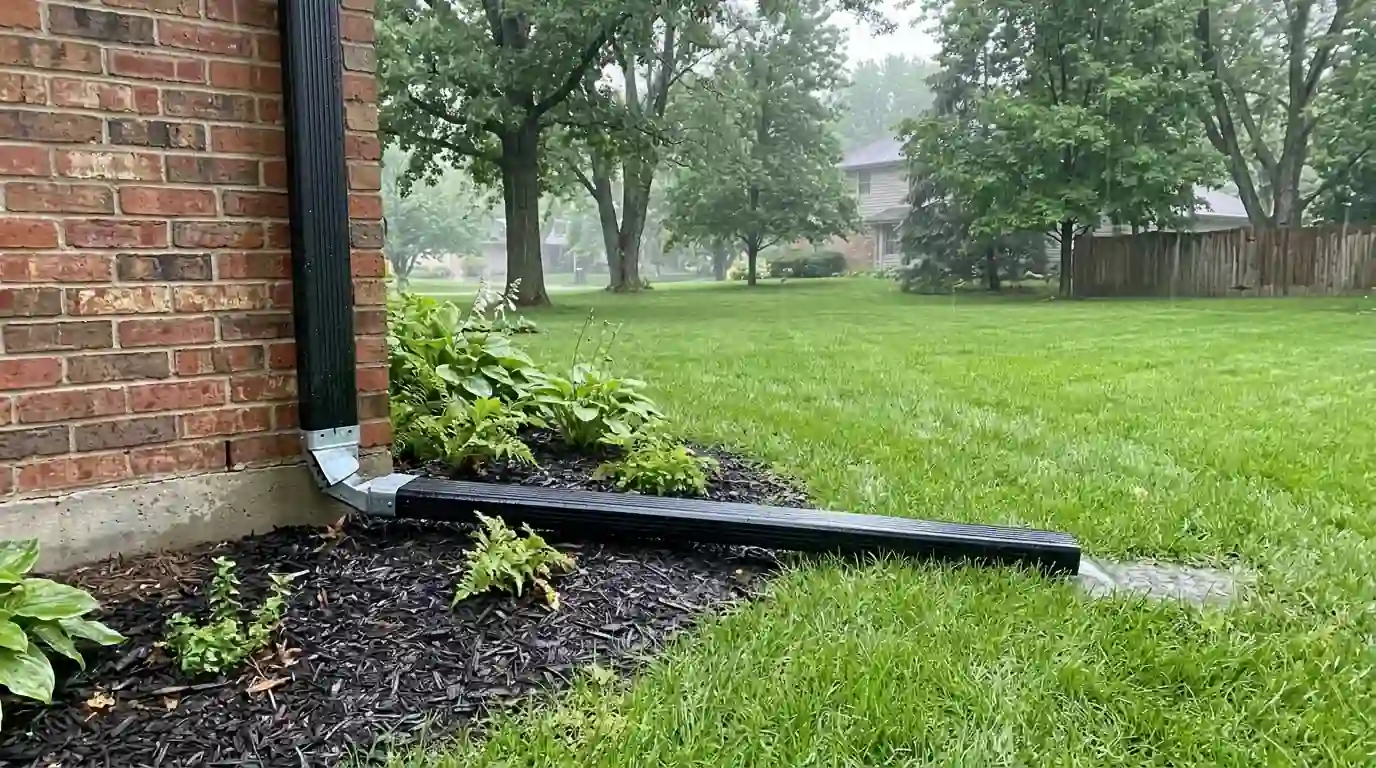
Nebraska Extension guidance says downspouts should discharge at least 5 feet from the foundation. The same guide recommends grading landscaped soil about 2 percent away from the house, roughly a quarter inch of fall per foot. Those two numbers do most of the work of keeping a basement dry.
Treat 5 feet as the minimum. If the yard is flat or tips back toward the house, carry the water farther, to a spot where the ground clearly runs away. On a walkout lot, aim discharge downhill and away from the lower patio door and the window wells.
- Set a level or a straight board on the ground at each downspout and look for back slope.
- Fill low spots against the wall with packed soil, not mulch or loose gravel.
- Keep finished grade several inches below the siding so it does not hold moisture against wood.
- Recheck after the first wet spring, because new fill settles too.
Choosing how to move the water
There are four common ways to get roof water from the downspout to a safe spot. The right one depends on how far you need to go and what stands in the way, such as a driveway, a patio or a planting bed.
On most houses the answer is a mix. Hinged downspout extensions work along the sides of the house, and a buried line handles the downspout that lands beside a driveway or a patio slab.
| Option | Best for | Watch out for |
|---|---|---|
| Splash block | Spots where the grade already falls away hard | Short reach, easily kicked out of place |
| Hinged or flip-up extension | Side yards and beds you mow around | Left flipped up after mowing |
| Buried solid pipe to an emitter | Long distances and paved areas | Needs steady slope and a clean outlet |
| Rain barrel with overflow | Garden water near a back downspout | Overflow still has to be carried away |
Getting buried lines right
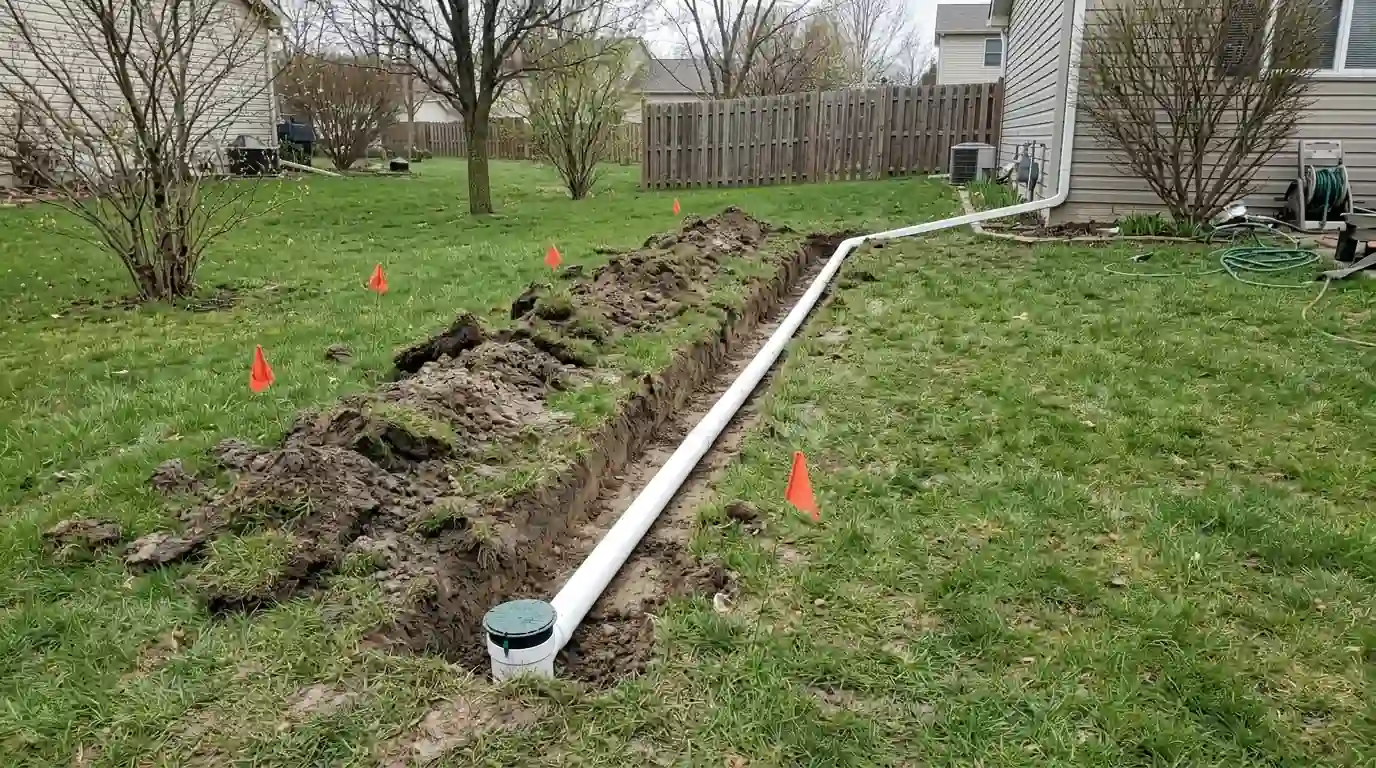
An underground line has to fall the whole way to its outlet, with no dips where grit and water can sit. Smooth-wall solid PVC holds its slope and can be flushed with a hose. Thin corrugated pipe is cheaper, but it sags between supports, traps grit and seed fluff in its ribs and is hard to clean.
The line should end at daylight on a slope or at a pop-up emitter in open lawn, with a cleanout near the downspout so a clog can be reached without digging. Our page on underground drain lines covers routing, outlets and cleanouts in more detail.
Before anyone digs, call 811 and wait for the utility lines to be marked. A shovel through a gas line or a buried fiber cable turns a drainage project into an emergency, and the trench for a downspout line often crosses right where those services enter the house.
Never into the sanitary sewer
It can be tempting to run a downspout into a floor drain, a sewer cleanout or an old clay pipe that seems to lead somewhere. Do not. Roof water belongs on the surface or in a dedicated storm system, never in the sanitary sewer, and local rules across the metro generally prohibit the connection. If you find an old tie-in, ask your city how to disconnect it.
In Omaha the stakes go beyond a code problem. The older core of the city is served by a combined sewer system covering about 43 square miles, with roughly 800 miles of pipe that carry sewage and stormwater together. In heavy rain those shared pipes can overload and push water back into basements, and every downspout piped into them adds to the load.
If you live in an older neighborhood and have had a sewer backup, ask a plumber about a backflow valve. The city has helped homeowners pay for them through a cost-share program. Keeping roof water out of the pipes is the part you control from the yard.
The gutter side of a dry basement
Grading and extensions only help if water reaches the downspout in the first place. A clogged gutter spills over its front edge and drops a curtain of water right along the foundation, skipping everything you set up below. Nebraska Extension recommends cleaning gutters and downspouts twice a year, and under cottonwoods and maples the spring clean matters most, as our cottonwood season guide explains.
Placement matters too. A downspout that lands at an inside corner beside a window well is a problem no extension fully solves. Sometimes the better repair is moving the outlet or adding a downspout at the other end of the run, so each pipe carries less water and lands somewhere better.
If you are not sure where your roof water ends up, call us. A gutter inspection follows each downspout from outlet to discharge and notes grade, clogs and placement.
What to check during the next storm
The fastest diagnosis there is costs nothing: put on a raincoat and walk around the house during a steady rain. Then look again an hour after it stops.
- Water pouring over the gutter face points to a clog or poor pitch.
- A downspout that only trickles in a downpour likely has a packed elbow, a job for downspout unclogging.
- Every extension should be down and pointing away from the house.
- Puddles within a few feet of the wall after the rain mean the grade needs work.
- Damp spots or white mineral deposits on basement walls near a downspout show where water is getting in.
Agatha Prewitt, Gutter Guides Editor
Writes the gutter guides for Hastings Seamless Gutters, drawing on what our crews see on Omaha roofs through hail season, cottonwood season and winter.
FAQ
Questions readers ask
How far should a downspout extension reach from an Omaha foundation?
Nebraska Extension recommends at least 5 feet, and farther is better when the yard is flat or tips back toward the house. The goal is to land water on ground that clearly slopes away, not just past a set mark. Near window wells and on walkout lots it often makes sense to go 8 to 10 feet or bury a line out to open lawn.
Can I connect my downspouts to a floor drain or sewer cleanout?
No. Roof water should never go into a sanitary sewer, and local rules generally forbid it. In older parts of Omaha the sewer pipes also carry stormwater, and heavy rain can already overload them and push water back into basements. Send downspout water to the surface instead, to a pop-up emitter in the lawn or to daylight on a slope.
Is corrugated pipe fine for a buried downspout line?
It can work on short runs laid in a firm, evenly sloped trench, but it has drawbacks. The ribs catch grit and seed fluff, the pipe sags between supports, and it crushes more easily under vehicles. Smooth solid PVC costs more but holds its slope, flushes clean and lasts longer. Perforated pipe should never carry downspout water along a foundation.
Will fixing my downspouts stop basement seepage on its own?
Roof water is often the largest single source of water near a foundation, so fixing discharge solves many damp basements. It cannot fix cracked walls, a high water table or a sewer backup. If the basement stays wet after downspouts discharge well away and the grade slopes out, bring in a foundation or waterproofing contractor. We handle the roof water and where it lands.
Questions about your own gutters?
Call and describe what you are seeing. The line is answered 24/7 and a crew can come out to measure.