Gutter guide
Seamless vs Sectional Gutters: What Changes on an Omaha House
Sectional gutters come home from the store in ten-foot lengths. Seamless gutters are rolled in your driveway to the length of each eave. The difference sounds small until you count the joints on a whole house.
By Agatha Prewitt, Gutter Guides EditorUpdated
The short answer
Seamless aluminum gutters have joints only at corners, end caps and outlets, so they leak far less and hold their pitch better through Omaha freeze-thaw winters. Sectional gutters, in vinyl or aluminum, are cheaper per foot and fine on a shed or a short run you plan to install yourself. On a house that sees summer downpours, hail and ice, the joint count usually decides it for seamless.
Call (402) 395-0908Counting the joints on a real house
Take a plain two-story house with a 44-foot front eave, a matching rear eave and two short side runs over a garage. Built sectional, that front eave alone needs five pieces and four splices, each one a slip joint or connector held together with sealant and a couple of rivets or a snap clip. Add the back of the house and the garage and you are past a dozen splices before counting a single corner.
Built seamless, the same house has no splices at all along its runs. The only sealed joints left are the mitered corners, the end caps and the spots where downspout outlets are cut in. Those exist on both systems. The difference is everything in between, and that is the part sectional gutters add.
Where sectional gutters give up first
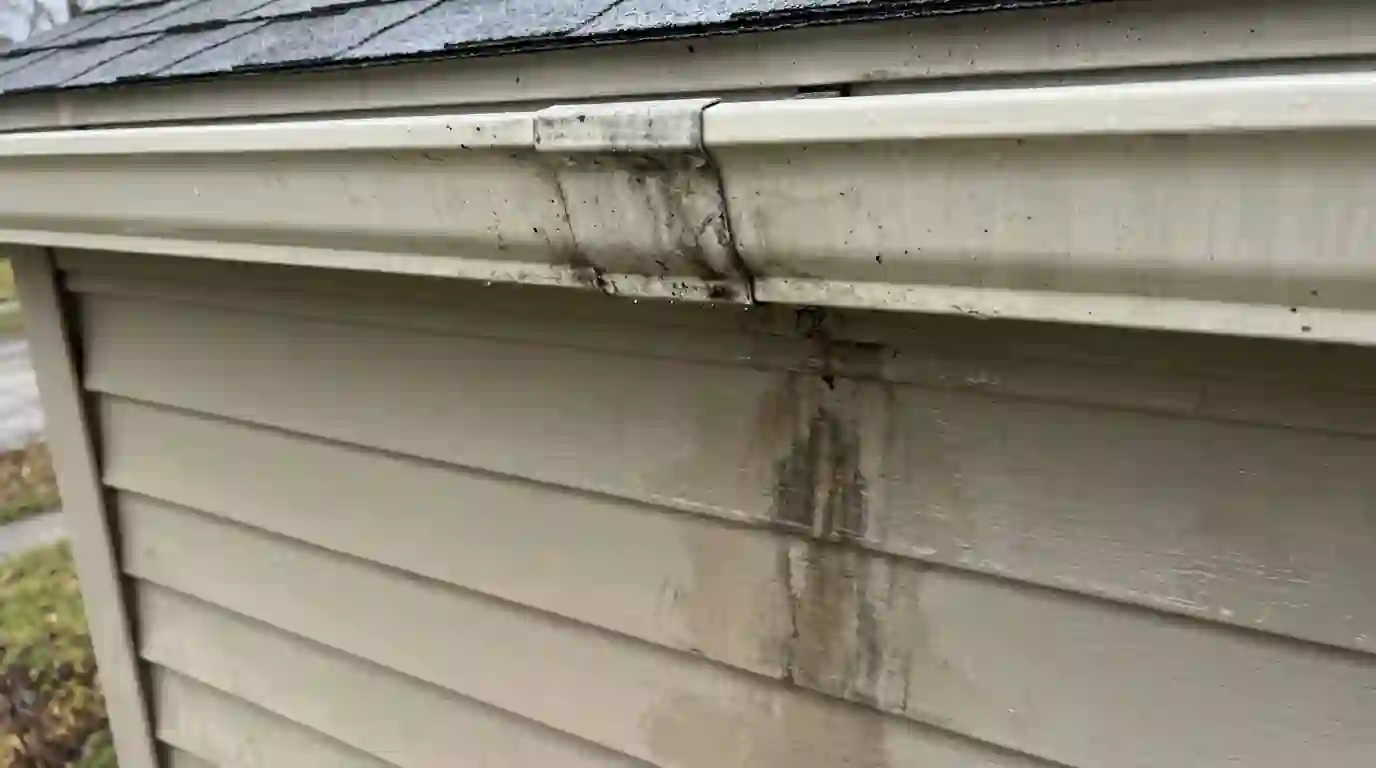
A splice is a lap of two metal or vinyl edges with a bead of sealant trapped between them. When it is new it is watertight. Then the sun bakes it in July, ice pries at it in January, and the two pieces move at slightly different rates every time the temperature swings. The sealant hardens, pulls loose on one side and opens a gap you cannot see from the ground.
Debris finds splices too. A lap joint leaves a small ledge inside the trough, and wet maple seeds, shingle grit and cottonwood fluff catch on it. Water then sits against the joint longer after every rain, which is exactly what wears the sealant out fastest.
- Drip lines or dirty stripes on siding directly under a splice
- Rust or white oxidation stains spreading from a joint on older steel or aluminum sections
- A dip in the run at a connector where the two pieces have shifted
- Snap-together vinyl joints that have separated after a cold night
- More caulk than metal visible on the inside of the trough
Why Omaha weather punishes splices
Omaha gets about 31.7 inches of rain and melted snow in a typical year, and the wettest stretch runs from May through August, with May averaging around 4.7 inches. Much of that comes in short, hard thunderstorms, so the gutter fills fast and water stands at the bottom of the trough exactly where the splices sit. A joint that weeps a little on a drizzly day runs like a faucet in a June cloudburst.
Winter adds the other half of the problem. Nebraska now has fewer days below freezing than it used to and more multi-day warm spells, which means more melting and refreezing inside gutters each season. Every freeze expands water caught in a splice. Over a few winters that is often enough to split a vinyl connector or lift an aluminum lap apart.
Hail is the third factor. Nebraska ranked first in the country for hail risk in a recent review of federal data. A dented sectional run is harder to straighten and reseal than a single seamless piece, and dents near a joint tend to open the seal right away.
The two systems side by side
Here is how the two compare on the points homeowners ask us about most. Material matters as much as format, so the sectional column covers both vinyl and aluminum pieces from the home center.
| Point | Seamless aluminum | Sectional vinyl or aluminum |
|---|---|---|
| Joints along a run | None, only corners, caps and outlets | One every 10 feet or so |
| Where it is made | Rolled on site from coil to exact length | Bought in stock lengths and pieced together |
| Common leak points | Corners and outlets | Every splice plus corners and outlets |
| Cold weather | Aluminum stays flexible below freezing | Vinyl turns brittle and can crack |
| Holding pitch | Stiffer run, fewer flex points | Connectors can shift and create low spots |
| Installer | Needs a roll former, so a gutter crew | Can be a weekend project on a small building |
| Price per foot | Higher | Lower |
Vinyl sectional is its own story
Most sectional gutters we take down in the metro are vinyl. Vinyl is light, does not dent and cuts with a hacksaw, which is why it shows up on so many do-it-yourself jobs. Its weak points are temperature and sunlight. Industry sources note that deep cold makes vinyl brittle enough to crack when ice or snow hits it, and that water freezing inside a vinyl trough can split it outright. It also moves more with temperature than metal does, so it sags between hangers on hot afternoons.
Lifespan follows from that. Typical figures put vinyl at about 10 to 15 years, against 20 to 30 years or more for aluminum, and in a snowy climate the low end is more common.
Vinyl also relies on rubber gaskets in snap-together connectors rather than sealant. Once a gasket shrinks or a connector pops in a cold snap, the leak is immediate. If your house has vinyl that is cracking or pulling apart, our page on vinyl to aluminum replacement explains how that swap goes, including the fascia check that should happen before anything new is hung.
When sectional still makes sense
We are not going to tell you every gutter in the world must be seamless. A short sectional run is a reasonable choice on a garden shed, a small lean-to or a dog run where a drip at a joint hurts nothing. It is also fine as a temporary fix on a building you plan to tear down or reroof soon.
Aluminum sectional pieces also let a homeowner patch a single damaged length after a limb strike without waiting on anyone. For garages, shops and pole barns that deserve something more permanent, our outbuilding gutter work uses the same seamless runs we put on houses, often in a larger size for metal roofs.
What a seamless run still needs to work
Seamless removes the splices, but it does not excuse poor installation. The run still needs hidden hangers screwed into sound fascia, a steady fall toward each outlet and downspouts large enough for the roof plane above them. A seamless gutter hung dead level will hold water just like a sectional one, and outlets placed too far apart will still overflow in a heavy storm.
Gauge and drainage matter too. Heavier .032 coil holds a straight line between hangers better than thin .027 on long eaves. On downspouts, a common sizing table credits a 3x4 with about 1,200 square feet of roof capacity against roughly 600 for a 2x3. The gutter size calculator gives a starting point from roof area and pitch, and our 5-inch vs 6-inch guide covers borderline cases.
| Item | Published range |
|---|---|
| Vinyl sectional gutters installed | $8 to $12 per foot |
| Seamless aluminum installed, Omaha estimate | $7.67 to $18 per foot |
| Seamless aluminum installed, national | $14 to $20 per foot |
| Resealing gutter seams | $1.50 to $6.50 per foot |
| Old gutter removal and disposal | $50 to $200 |
National ranges published by HomeGuide, Handoff, Fixr. Your price depends on the house; we give you a number on the phone or at the house before any work starts. See the full gutter price guide.
Cost and the long view
Sectional vinyl costs less per foot installed, and seamless aluminum costs more, as the price rows below show. On a typical house the gap is real but not huge, because labor, corners, downspouts and tear-off make up a large part of either job.
The fairer comparison is what you pay over time. A sectional system that needs its splices resealed every few seasons, or that cracks and has to come down early, closes most of that gap. Factor in water that leaked onto fascia, siding and the ground along the foundation in the meantime, and seamless usually comes out ahead on a house you plan to stay in. Our Omaha gutter cost guide walks through the rest of a quote.
If you are weighing the two on your own house, call us. We will measure each eave, count what a sectional build would need and price a seamless installation so you can compare real numbers.
Agatha Prewitt, Gutter Guides Editor
Writes the gutter guides for Hastings Seamless Gutters, drawing on what our crews see on Omaha roofs through hail season, cottonwood season and winter.
FAQ
Questions readers ask
Can a leaking sectional gutter splice be fixed instead of replacing the whole run?
Usually, yes, for a while. The joint is taken apart or scraped clean, dried, resealed with a sealant made for gutters and re-riveted. That holds for a few seasons. If several splices on the same house are leaking, or the metal around them is rusted or cracked, the repairs start to add up and converting those runs to seamless is often the better use of the money.
Are seamless gutters really one piece around the whole house?
No. Each straight run along an eave is one piece, formed to that exact length. Where the roof turns a corner, two runs meet at a mitered corner that is riveted and sealed. End caps and downspout outlets are also sealed joints. What seamless eliminates is the splice every ten feet or so in the middle of a run, which is where sectional gutters most often leak.
Is vinyl sectional gutter good enough for a Nebraska house?
It can work on a small building, but it struggles on a house here. Vinyl gets brittle in January cold and can crack at connectors, then softens and sags between hangers in July heat. Snap joints rely on rubber gaskets that shrink with age. Aluminum handles both extremes far better, which is why most of the vinyl systems we see end up replaced.
Can new seamless gutters connect to my existing sectional ones?
Technically a seamless run can meet an old sectional run at a corner, as long as the profile and size match. It rarely makes sense, though, because the old side keeps all of its splices and usually fails first. Colors also rarely match after years of sun. Where budget is tight, we suggest replacing the runs that leak worst and planning the rest for later.
Questions about your own gutters?
Call and describe what you are seeing. The line is answered 24/7 and a crew can come out to measure.